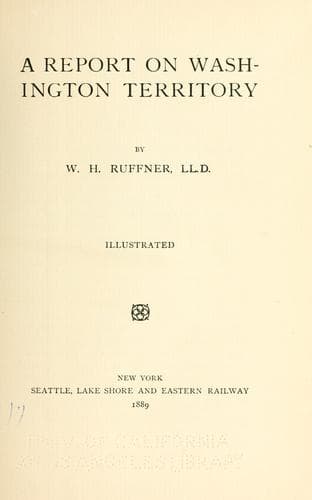
A Report on Washington TerritoryRuffner, William Henry
History
A Report on Washington Territory
Ruffner, William Henry
Washington (State)
Assuming that Spokane Falls is the objective point of the Seattle
Railway, I will give a somewhat full account of this thriving young
city. In 1882 it had 700 inhabitants; in 1887 it had over 7,000. In 1883
the Northern Pacific Railroad reached there, and since that date the
town has grown continuously. It will be a large city, as will be obvious
if its advantages be considered. These are chiefly: I. Its water-power;
II. Its agricultural relations; III. Its mining surroundings; IV. Its
railroad prospects; V. Its good ground for building.
[Sidenote: Mr. Paul F. Mohr's article.]
I. ITS WATER-POWER.--The value of this water-power arises partly from
the volume of water and its great fall, and also its uniformity, and its
freedom from disturbing causes. The river falls in a succession of
cascades amounting to 156 feet within the limits of the city. Mr. Paul
F. Mohr has published an intelligent article on the subject, from which
I quote the following statements:
"To arrive at the available number of horse-power which the Spokane
River could furnish at this point, assuming 90,000 horse-power as
the gross power of the river, and deducting 60 per cent. therefrom,
would leave 36,000 horse-power as a most conservative and minimum
estimate.
"The City of Minneapolis used in 1880, as nearly as I can ascertain,
about 20,000 horse-power, and Minneapolis is probably the largest
flour-milling point in the world.
"The industries requiring most power are, in their order, as
follows: lumber, flour, iron and steel, paper, woolen goods and
worsted goods, with several industries consuming a comparatively
small amount of power, not necessary to mention. Of the industries
above named, all but the iron and steel industries can be followed
at this point, and, in fact, the flouring, paper and woolen
industries belong to this section of the country."
It is claimed that the Spokane River at the falls never rises more than
six feet, and never freezes. The river here has cut so deeply into the
basalt, that there must be combination among the riparian owners in
order to draw the water to good mill sites, and invite manufacturers to
use the power. Mr. Mohr urges this.
Two flour-mills are now there turning out about 450 barrels of flour a
day; also saw-mills, and, I think, a dynamo for electric lights, etc.;
but, of course, these use but a small part of the power, which, if fully
utilized, in such ways as are suggested by Mr. Mohr, would of itself
create a large city.
II. AGRICULTURAL RELATIONS.--Spokane Falls has a promising agricultural
country on all sides. The Pend d'Oreille region has good agricultural
capabilities, though the best lands there are in the Indian reservation.
Public-domain text, read in full here on John Shaqi.
Reviews
Reviews
No reviews yet
Be the first to share your thoughts on this work.
Elsewhere in the archive
Join the Discussion
Join the discussion
Sign in to leave a comment or review.
Sign InorCreate an account