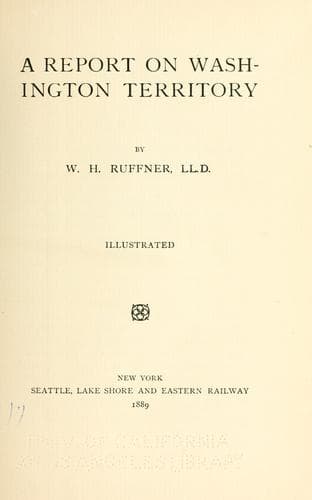
A Report on Washington TerritoryRuffner, William Henry
History
A Report on Washington Territory
Ruffner, William Henry
Washington (State)
The country north of Spokane Falls, in the direction of Colville, is
spoken of as a fertile valley, having more rain than the plateau
country, much of it limestone soil, specially productive in hay and
wheat. The wheat is harder than the plateau wheat, and contains a larger
proportion of gluten; hence it is desired as a mixture for the wheat
that is usually brought to the Spokane Falls mills.
Turning to the great plateau, we find that the rich Palouse River
country, since the construction of the Spokane Falls and Palouse
Railroad finds its readiest market at Spokane Falls. And now that the
Seattle, Lake Shore and Eastern Railroad is striking out through the
Great Bend, another portion of this great producing region will be
brought within easy reach.
III. MINING INTERESTS.--I need here only refer to the fact that Spokane
Falls is situated centrally with regard to the mines of precious and
base metals heretofore described. Evidently the business from the mines
of Chewelah, Colville, Little Dalles, Kootenai, etc., must come here
except so far as it may be diverted to a tide-water city which would
smelt their ores and sell them goods. No doubt the Canadian Pacific will
handle some of the business of the Kootenai mines. Similar remarks may
be made with regard to the mines of the Coeur d'Alene country, with
the qualification that a road crossing the mountain, say to Missoula,
would divert some of the trade to Helena or Butte City.
The miners of Okanogan, Methow, etc., would be nearest to Spokane Falls,
but would be 100 or 150 miles on the way to Puget Sound, which would
divide the trade.
IV. RAILROAD PROSPECTS.--The Northern Pacific Railroad, a
transcontinental line, already passes through Spokane Falls. If the
cut-off through the Coeur d'Alene country should be made, it would be
equivalent to an additional road. The Spokane Falls and Palouse Railway
joins the Northern Pacific at Marshall, only nine miles from the city,
and its general course points directly toward it.
The road across the Great Bend has been commenced. The road to Colville,
Little Dalles, etc., will inevitably be made at an early day.
This would make it really the centre of six roads, counting the Northern
Pacific as two.
V. BUILDING GROUNDS.--The city is built and building on both sides of
the river, and stands on a level, dry, gravelly plain, a mile or more in
width, rising into wooded hills. In other words, it has all that can be
desired for situation.
[Sidenote: Sprague, Colfax, and Lewiston.]
Sprague, Colfax, and Lewiston claim attention as indicating the points
in a proposed branch line of railroad, leaving the Seattle, Lake Shore
and Eastern Railway somewhere in the Great Bend country.
Public-domain text, read in full here on John Shaqi.
Reviews
Reviews
No reviews yet
Be the first to share your thoughts on this work.
Elsewhere in the archive
Join the Discussion
Join the discussion
Sign in to leave a comment or review.
Sign InorCreate an account