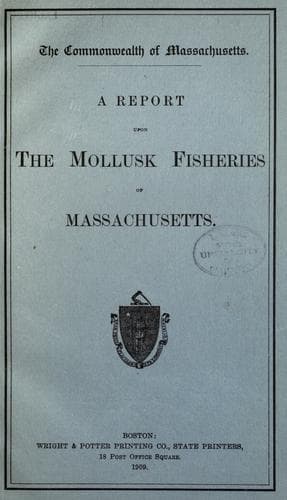
A Report upon the Mollusk Fisheries of MassachusettsMassachusetts. Commissioners on Fisheries and Game
Science
A Report upon the Mollusk Fisheries of Massachusetts
Massachusetts. Commissioners on Fisheries and Game
Shellfish fisheries -- Massachusetts
The oyster industry at Marion is practically dead. The last grants
expired some ten or twelve years ago, and were never renewed. Of the
two original natural beds, that in Blankinship's Cove is now almost
entirely depleted, while the larger and more important bed in the
Weweantit River has greatly declined in importance. This bed, however,
still supplies all the marketable oysters produced within the town,
though the annual production is insignificant. From twenty-five to
thirty years ago the oyster industry had its beginning, and for a time
flourished. Almost all the available territory, both in the harbor and
in the Weweantit River, was granted. The older grants were leased for
fifteen years, and those of later date were arranged to run out at the
same time; so it followed that all the leases expired simultaneously,
and the industry came to an abrupt end. These old grants were not
renewed, for two reasons: first, they had not paid very well; and,
secondly, the growing quahaug industry promised more lucrative returns.
The scallops, too, began to be abundant, and the old oyster business
gave way before its newer and more prosperous competitors.
_Fall River District._
The Fall River district, comprising the six towns of Fall River,
Freetown, Berkley, Dighton, Somerset and Swansea, may best be treated
as a geographical unit. The oyster industries of the individual
communities overlap to a considerable extent, and make distinct
separation difficult, while, as the same methods of culture everywhere
obtain and the same problems and difficulties are encountered, a brief
survey of this whole region may be comprehensively discussed in one
article.
The beautiful shores of Mount Hope Bay and its tributary streams, the
Cole, Lee and Taunton rivers, furnish an extensive territory for a
large oyster industry. The best of this area is now included within the
confines of the bay itself, though the Cole and Lee rivers furnish a
small but valuable addition. The Taunton River, however, which thirty
years ago produced the finest oysters in the State, and was the main
source of supply for this district, has become utterly worthless
for the growth of marketable oysters. In fact, this river, with its
curious history, and the difficulties which it now presents to the
carrying on of an important and profitable industry, furnishes the
most interesting problem of this whole region. This river embraces the
entire oyster territory of Freetown, Berkley and Dighton and portions
of Somerset and Fall River,--certainly half of all the available
territory of the whole section; and yet it is an indisputable fact that
this large and formerly profitable area is now altogether unsuitable
for the production of edible shellfish.
Public-domain text, read in full here on John Shaqi.
Reviews
Reviews
No reviews yet
Be the first to share your thoughts on this work.
Elsewhere in the archive
Join the Discussion
Join the discussion
Sign in to leave a comment or review.
Sign InorCreate an account