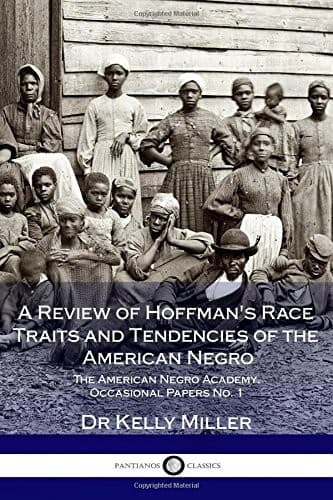
A Review of Hoffman's Race Traits and Tendencies of the American Negro: The American Negro Academy. Occasional Papers No. 1 — John Shaqi
A Review of Hoffman's Race Traits and Tendencies of the American Negro: The American Negro Academy. Occasional Papers No. 1Miller, Kelly
Philosophy
A Review of Hoffman's Race Traits and Tendencies of the American Negro: The American Negro Academy. Occasional Papers No. 1
Miller, Kelly
African Americans; Hoffman, Frederick L. (Frederick Ludwig), 1865-1946. Race traits and tendencies of the American Negro
To the Negro I would say, let him not be discouraged at the ugly facts
which confront him. The sociologists are flashing the searchlight of
scientific inquiry upon him. His faults lie nearer the surface and are
more easily detected than those of the white race. Let him not be
overwhelmed when all his faults are observed, set in a note book,
learned and conned by rote, to be cast into his teeth. If all the ugly
facts about any people were brought to light they would furnish an
unpleasant record. When the Savior told the woman of Samaria all that
she ever did, a very unsavory career was disclosed. If all the misdeeds
of any people or individual were brought to light, the best of the race
would be injured and the rest would be ruined. The Negro should accept
the facts with becoming humility, and strive to live in closer
conformity with the requirements of human and divine law. He does not
labor under a destiny of death from which there is no escape. It is a
condition and not a theory that confronts him.
KELLY MILLER.
Footnotes:
[1] Author's preface.
[2] Page 51.
[3] Page 95.
[4] Page 95.
[5] Page 176.
[6] Page 312.
[7] Page 311.
[8] Frederick L. Hoffman, in the Arena, April, 1892.
[9] Giddings' "Principles of Sociology," page 79.
[10] Senator Roger Q. Mills, in the Forum, April, 1891.
[11] Estimated by General Francis A. Walker, Forum, July, 1891.
[12] W. E. B. Du Bois, Ph. D., in the American Academy of Political
Science, January, 1897.
[13] Miles Menander Dawson, in the Quarterly Publications of the
American Statistical Association, September-December, 1896, page 142.
[14] Page 14.
[15] General Francis A. Walker, Forum, July, 1891.
[16] Page 20.
[17] See New York Evangelist, June, 1897.
[18] Page 37.
[19] The Health Officer of Savannah, quoted by Mr. Hoffman, page 62.
[20] Page 63.
[21] Page 33.
[22] M. G. Mulhall, F. S. S., in North American Review, July, 1897.
[23] Tenth Census, Vol. XI, p. xxxviii.
[24] Dr. John S. Billings' comments upon Vital Statistics of the Tenth
Census, Vol. XI, p. xxxviii.
[25] Pages 53 and 54.
[26] Report of the Health Officer of the District of Columbia, 1896,
page 7.
[27] Pages 53 and 55.
[28] Bulletin of the Department of Labor, No. 10, May, 1897, page 286.
[29] Surgeon General's Report, 1896, Table XII.
[30] Dr. Francis A. Walker, in the Forum, July, 1891.
[31] Page 148.
[32] "The Effects of Emancipation upon the Mental and Physical Health of
the Negro," by Dr. J. F. Miller, Superintendent Eastern Hospital,
Goldsboro, N. C., page 2.
[33] Ibid., page 6.
[34] Report of Surgeon General of the Army, August, 1896, page 89.
[35] L. M. Hershaw, Esq., in Atlanta University Bulletin, No. 2. page
16.
[36] Page 176.
[37] Page 149.
[38] Page 158.
[39] Page 176.
[40] Page 188.
[41] "Plantation Negro as a Freeman," by Phillip A. Bruce, pages 53 and
54.
[42] Page 185.
[43] Appleton's Popular Science Monthly, March, 1897.
[44] A. De Quatrefages' "Human Species," chapter XXX.
Public-domain text, read in full here on John Shaqi.
Reviews
Reviews
No reviews yet
Be the first to share your thoughts on this work.
Join the Discussion
Join the discussion
Sign in to leave a comment or review.
Sign InorCreate an account