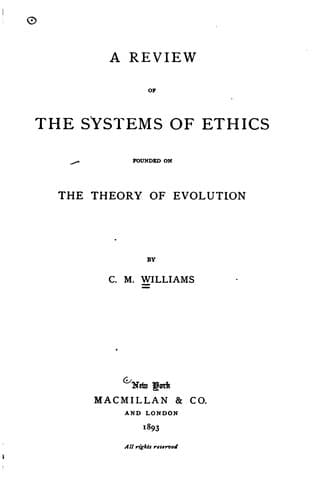
A Review of the Systems of Ethics Founded on the Theory of EvolutionWilliams, Cora May
Philosophy
A Review of the Systems of Ethics Founded on the Theory of Evolution
Williams, Cora May
Ethics, Evolutionary
The objection that, if pain is the motive, the organism is nothing but a
bundle of pains, is by no means valid, for it overlooks the fact that
pain remains, in an immense number of cases, below the threshold of
consciousness; as in the case of organic action, where it is rhythmic.
The same is true of reflex action. To any close observer of the lower
organisms, it seems most probable that these possess consciousness (see
Wundt, "Physiologische Psychologie"), nor is it by any means proved that
the plants do not possess it likewise. It is certainly remarkable that
exactly the lowest plants, which stand so near the animals in the
phenomena of their life, exhibit movements closely resembling those of
animals. And it is, moreover, a fact that automatic and reflex actions
increase with the degree of organization, and are most numerous in human
beings. With increased exercise, one chain of movements after the other
is withdrawn from consciousness; and through this removal from
consciousness action gains in certainty and rapidity, and in energy
also, since the part of the force which was before lost in inducing
consciousness is now released. Such removal from consciousness is,
therefore, a benefit to the organism, as an adaptation to the increased
demands of circumstances. Movements which thus become unconscious are
each and every one of them movements which have but one definite end and
an interruption of which either kills or seriously injures the organism,
or at least brings disorder into its life for the time being. An easily
excited consciousness would be an exceeding danger to the animal.
Conscious action is directed to the attainment of variable ends by means
which are also variable. It cannot, therefore, astonish us that
consciousness disappeared in plants after the loss of free motion.
By the regular exercise of certain actions or of trains of thought,
either through necessity or by habit certain tracks are worn or taken
possession of, so that the whole process, from the excitation to the
action resulting upon it, takes place with such rapidity that we are no
longer conscious of its separate phases and so of the growth of the
result.
Public-domain text, read in full here on John Shaqi.
Reviews
Reviews
No reviews yet
Be the first to share your thoughts on this work.
Elsewhere in the archive
Join the Discussion
Join the discussion
Sign in to leave a comment or review.
Sign InorCreate an account