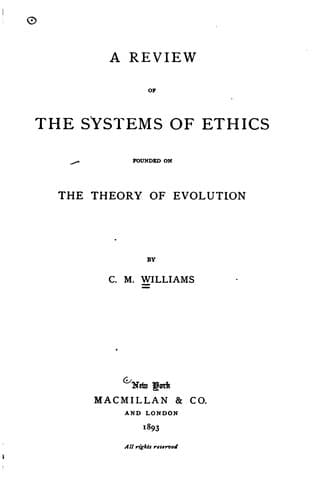
A Review of the Systems of Ethics Founded on the Theory of EvolutionWilliams, Cora May
Philosophy
A Review of the Systems of Ethics Founded on the Theory of Evolution
Williams, Cora May
Ethics, Evolutionary
The first commandment of animal ethics is, therefore: "Flee pain"; and
closely associated with it is a second commandment furnished by the
insatiability of the organism, the impulse to happiness, to increase of
life. The principle of Spencer's ethics, according to which normal
living is right living, would result in stagnation. Right living
consists, on the contrary, in progress, in passing beyond the normal. No
educator would hesitate for an instant to pronounce the continuance of a
pupil upon a present normal immoral, and to oppose it with all his
powers. From day to day the developing organism advances the line of its
normal activity. And as in the individual, so in the species: every new
generation exceeds in a certain measure the activity of the last. Not
rest, but motion, constitutes the normal; not rest, but motion, is
happiness, and the spring of happiness. Not that being which has no
wants, but that which develops and satisfies the greatest possible
number of wants, is the happiest, leads the most pleasurable life. When
we apply these principles to the animals, we reach the conception that
all such as lead a solitary life live morally when they endeavor, with
all their powers, to better their own condition. That they injure plants
and other animals in so doing need not trouble us, since they are forced
to do so in order to maintain life. The principle on which animal life
is based is hence preeminently egoistic and acknowledges no other right
than that of might. Spencer, in speaking of altruism on the lowest plane
of animal life, makes the fundamental and quite fatal mistake that he
does not first sharply and distinctly define egoism. Had he done this,
he would certainly have found that, for egoism, as for altruism, the
criterion of consciousness, of will, is indispensable. In his definition
of altruism as consisting in those acts which in any way benefit others,
he does nothing less than get rid of egoism altogether, since there are
no acts which do not, in the end, benefit others than the performer. The
greater number of the young brought forth by lowest organisms serve as
food for other species, and hence the parent animal, in bringing forth
such numbers, favors these species rather than her own flesh and blood.
The fly would act altruistically, according to Spencer's definition, in
being caught in the net of the spider.
Public-domain text, read in full here on John Shaqi.
Reviews
Reviews
No reviews yet
Be the first to share your thoughts on this work.
Elsewhere in the archive
Join the Discussion
Join the discussion
Sign in to leave a comment or review.
Sign InorCreate an account