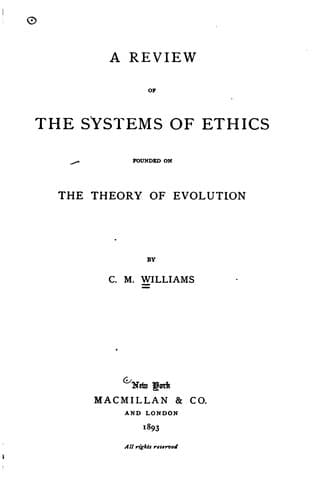
A Review of the Systems of Ethics Founded on the Theory of EvolutionWilliams, Cora May
Philosophy
A Review of the Systems of Ethics Founded on the Theory of Evolution
Williams, Cora May
Ethics, Evolutionary
Closer association gives opportunity for a misuse of the powers and aims
of the individual, before impossible. Examples of this are the theft of
honey from one hive of bees by the workers of another, and the carrying
off of the young by wasps and ants, as also the slaughter of the drones.
Since the robber of yesterday may be the robbed of to-day, such acts are
harmful to individuals, to the family, and to the species. They diminish
the degree of life, and are opposed to animal ethics. The association of
male and female, since only temporary, affords little opportunity for
immorality, and the duties of parents to their young are, for the most
part, faithfully performed. In striking contrast to the natural morality
of wild animals is the immorality of domestic animals, which give
themselves up to every sort of vice when not restrained. The moral
conditions of any associated animals not under control, whether in
zooelogical gardens, in the town, or in the country, is, in fact,
monstrous. Immorality increases with the closer association of animals.
The closer the contact and the looser the bond between the individuals
of a species, the greater the opportunity for immorality, and the worse
the resulting habits. The careless life of pleasure led by animals that
live in solitude, is interfered with, in a state of association, by
certain duties. How far the performance of such duties springs from a
concealed pleasure, or from instinct, or follows upon the command of
authority, we, unfortunately, cannot say. The limitation of
gratification signifies, however, decrease of pleasure. The needs of
different animals differ according to differing organization; higher
organization means greater and more complicated desire, the satisfaction
of which is often impossible, but it means also the attainment of
capacity for greater pleasure in form and intensity. Hence even the
partly attained pleasure of the higher animals is, in intensity as well
as in fulness, much greater than the completely attained pleasure of the
lower animals.
HUMANE ETHICS
Rolph contests Lubbock's theory that the early type of man lived in a
condition of sexual promiscuity, and gives as a reason for his opinion
the "strict" monogamy of those animals which are most closely related to
man. The customs of such animals should have as much weight, as
evidence, as those of any of the present tribes of savages, since these
tribes are as old as civilized races, and their customs cannot,
therefore, be unhesitatingly regarded as primary ones.
Public-domain text, read in full here on John Shaqi.
Reviews
Reviews
No reviews yet
Be the first to share your thoughts on this work.
Elsewhere in the archive
Join the Discussion
Join the discussion
Sign in to leave a comment or review.
Sign InorCreate an account