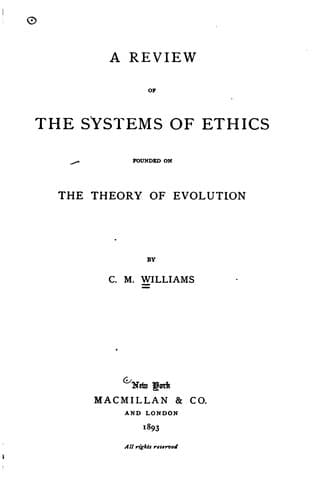
A Review of the Systems of Ethics Founded on the Theory of EvolutionWilliams, Cora May
Philosophy
A Review of the Systems of Ethics Founded on the Theory of Evolution
Williams, Cora May
Ethics, Evolutionary
The real needs of men, those the gratification of which is indispensable
to the maintenance of life, are few. By experience, and by experience
alone, can man learn that present gratification may mean future pain,
and so be withheld from such gratification; for only disinclination to
one form of pleasure can induce inclination to another form. In the
simplicity of primitive social conditions and the uniform character of
action under such conditions, rules of experience must have been early
formed, which, inherited by succeeding generations, became the rules of
conduct.[61] With the development of authority,--first the paternal
authority, then that of the family, and finally that of the elders of
the tribe,--the possibility of establishing rules of action, and
inducing morality, increased. The very nomination of elders, to which
primitive authority may almost everywhere be traced, shows how great was
the respect for experience.
Spencer remarks, in one place in his "Data of Ethics," that human beings
first banded themselves together because they found it more advantageous
to cooeperate. This is only conditionally true. Before human beings could
find association advantageous, they must have accumulated experience of
it. That they did this by their own inclination is certainly not true.
Wherever we find two solitary beings coming together by chance, enmity
is the first feeling excited, and war the result. Everything new,
everything unknown, causes aversion, and this aversion must lead to
misunderstandings and war the more surely because each of the opponents
feels himself disturbed in his supposed right to limitless possession.
Human beings must first have warred with one another before they came to
the knowledge, not that social life, that is, mutual forbearance, was
more advantageous, but that more closely associated individuals gained
in power against a common enemy by their association. Man did not choose
society, but was, on the contrary, forced into it, for good or evil,
through increase of his kind. The discovery of the first tools must have
had an immense influence upon increase in the number of individuals,
which was before limited by struggle with wild animals, and by the
restriction of food to fruit. We must conclude that, under such
circumstances, a lasting contract was inevitable, and that, with it,
vices suddenly appeared which had before existed only potentially, as
predisposition. War or theft must have followed the mutual limitation of
rights, but against this disturbance of the peace other members of the
society must have banded themselves together. The weaker must soon have
been driven from their possessions by the stronger, and must then have
united for the purpose of obtaining, by association, what they were
unable to acquire otherwise. The growing children settled near their
parents, with whom they entered into a family union, in which the father
represented the authority. In this arrangement is the germ of civil
Public-domain text, read in full here on John Shaqi.
Reviews
Reviews
No reviews yet
Be the first to share your thoughts on this work.
Elsewhere in the archive
Join the Discussion
Join the discussion
Sign in to leave a comment or review.
Sign InorCreate an account