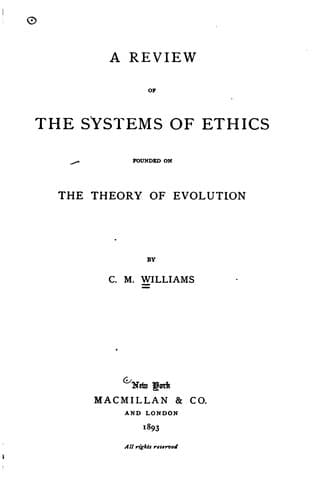
A Review of the Systems of Ethics Founded on the Theory of EvolutionWilliams, Cora May
Philosophy
A Review of the Systems of Ethics Founded on the Theory of Evolution
Williams, Cora May
Ethics, Evolutionary
answer to the question might bring out the fact, which seems on other
grounds probable, that it is an advantage to a race to include a great
variety of different types. It is enough, however, to say that, in
speaking of a type, the assertion is not intended, that there is one
special type conformity to which is a condition of efficiency, but that
evolution is always the working out of a problem, the solution of which
implies the attainment of certain general qualities.
We have changed our point of view from the consideration of pain and
pleasure to that of the conditions of existence. The fact is simply,
that the constants in one problem are variables in the other. Given a
certain character, the agent does what gives him pleasure. But if we ask
how he comes to have that character, the only mode of answering is by
referring to the conditions of existence. His character must be such as
to fit him for the struggle for existence. There must therefore be a
correlation between painful and pernicious actions on the one hand, and
pleasurable and temporal on the other. The useful in the sense of the
pleasure-giving must approximately coincide with the useful in the sense
of the life-preserving. All conduct may be considered as a set of
habits, to each of which there is a corresponding instinct--the word
habit being used to designate any mode of conduct, automatic or
voluntary, which may be brought under a general rule, instinct denoting
all conscious impulses to action, whether including more or less
reasoned choice, and whether innate or acquired. Habits graduate from
the essential processes which constitute life rather than maintain it,
and which are, for the most part, automatic, to the most superficial and
transitory. In order that the proposition "This habit is a bad one" may
have any real meaning, we must assume that the organism can exist
without it. A habit cannot be removed as one takes off a coat, as has
been too often assumed; the whole character of the man is affected by
its removal.
Public-domain text, read in full here on John Shaqi.
Reviews
Reviews
No reviews yet
Be the first to share your thoughts on this work.
Elsewhere in the archive
Join the Discussion
Join the discussion
Sign in to leave a comment or review.
Sign InorCreate an account