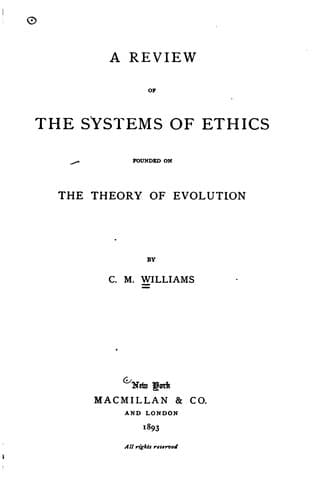
A Review of the Systems of Ethics Founded on the Theory of EvolutionWilliams, Cora May
Philosophy
A Review of the Systems of Ethics Founded on the Theory of Evolution
Williams, Cora May
Ethics, Evolutionary
The development of the whole nature implies a development of both the
emotional and the intellectual nature; new sensibilities imply new
sentiments; and increased range of thought is associated with an equal
growth in complexity and variety of emotion. The more reasonable being
acts with emotion, but his emotions have more complex and refined
methods. The reasonable man is a better mirror of the world without him,
his conduct shows a better adaptation to ends and a greater logical
consistency in its parts; more harmony of action between the different
instincts. The important question is not solved by these facts. We may
still ask: How is the relation between the different instincts, the
influence exerted by each member of the federation, determined?
We start with certain fixed relations between our various instincts; and
however these may change afterwards, our character is so far determined
from the start. Again, it is plain that this inherited balance varies
greatly with different peoples and gives rise to different types. In one
man the sensual passions have a greater relative importance than in his
neighbor, and so forth. And the question arises, whether we can
determine which of these types is most reasonable.
In the construction of the bow, we may suppose that, from rude
beginnings, through discovery of better and better forms as adapted to
ends in view in its construction, a form of bow would finally be reached
which would represent the maximum of efficiency. This bow may be called
the typical bow. As exquisitely adapted to its purpose, it arouses in us
aesthetic satisfaction. Like the bow, every organism represents the
solution of a problem, as well as a set of data for a new problem. As
the bow is felt out, so the animal is always feeling itself out. The
problem which it solves is how to hold its own against the surrounding
pressure and the active competition of innumerable rivals. Though we
cannot apply an _a priori_ method, cannot define the materials of which
men are made or the end which they have to fulfil, we can determine to
some extent their typical excellence. Recognizing the general nature of
the great problem which is being worked out, we can discover what is
implied in some of the results. The process of evolution must be, at
every moment, a process of discovering a maximum of efficiency; though
the conditions are always varying slowly, and an absolute maximum is
inconceivable. At every point of the process, there is a certain
determinate direction along which development must take place. The form
which represents this direction is the typical form, any deviation from
which is a defect. It is conceivable that the highest efficiency in
different departments of conduct may imply consistent conditions. The
greatest philosopher may also be the greatest athlete and the greatest
poet. It is equally clear that there is no necessary connection. What,
then, is the relative value of different kinds of efficiency? A complete
Public-domain text, read in full here on John Shaqi.
Reviews
Reviews
No reviews yet
Be the first to share your thoughts on this work.
Elsewhere in the archive
Join the Discussion
Join the discussion
Sign in to leave a comment or review.
Sign InorCreate an account