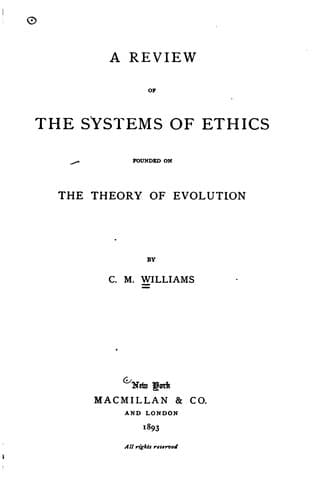
A Review of the Systems of Ethics Founded on the Theory of EvolutionWilliams, Cora May
Philosophy
A Review of the Systems of Ethics Founded on the Theory of Evolution
Williams, Cora May
Ethics, Evolutionary
An organization implies organs; and these are to be found in the various
organizations, political, religious, etc., by which, through a greater
or less division of labor, certain special functions are relegated to
particular associations. We thus have not only to go beyond the
individual and refer to the organs in order to determine the "law" or
form of any instinct developed through the social factor, but we have
also to classify the various social instincts by reference to the
complex structure of society, which implies a distribution into mutually
dependent organs. Moreover, such organs, though primarily directed to a
specific end, acquire a vitality independent of any special end, become
organs discharging a complex function, and imply the existence of a
correspondingly complex set of instincts. We come really to love an
organization because it supplies us with a means of cultivating certain
emotions and of enjoying the society of our fellows; it would be an
entirely inadequate account of the facts if we regarded it simply as the
means of attaining that pleasure which has given the pretext for its
formation.
The organs of society are not, however, distinct from each other as the
physical organs are distinct; the same individuals may be members of
various organizations. The race is not, in fact, analogous to the higher
organism, which forms a whole separated from all similar wholes, but to
an organism of the lower type, which consists of mutually connected
parts spreading independently in dependence upon external conditions,
and capable of indefinite extension, not of united growth. We may
consider the race, thus, as forming social tissue, rather than
constituting an organism. The tissue is built up of men, as the tissue
of physiology is said to be built up of cells. The laws of growth and
vitality of the organs of society are always relative to the underlying
properties of the tissue; although, in particular cases, the more
civilized race may be supplanted by the less civilized, we may assume
that these accidental and contingent advantages will be eliminated on
the average, and the general tendency will be to the predominance of
those races which have intrinsically the strongest tissue. Not the state
as such, and (as we have seen) not the individual, is the unit of
evolution; the state may develop when the external pressure is little or
nothing; the social tissue is that primary unit upon which the process
of social evolution impinges. The family is not, itself, a mode of
organization cooerdinate with other social organs, but rather represents
the immediate and primitive relation which holds men together. It is
quite possible to suppose men living together without any political and
social organization; but some association between the sexes, however
temporary and casual, and some protection of infants by parents, are
absolutely necessary to the continuance of the race beyond a single
generation.
Public-domain text, read in full here on John Shaqi.
Reviews
Reviews
No reviews yet
Be the first to share your thoughts on this work.
Elsewhere in the archive
Join the Discussion
Join the discussion
Sign in to leave a comment or review.
Sign InorCreate an account