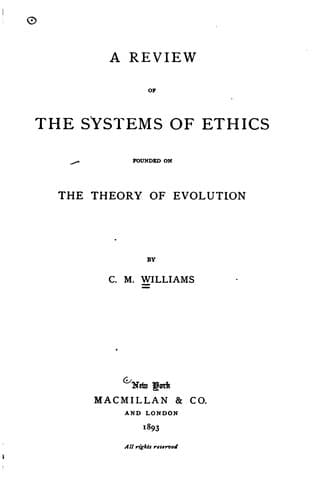
A Review of the Systems of Ethics Founded on the Theory of EvolutionWilliams, Cora May
Philosophy
A Review of the Systems of Ethics Founded on the Theory of Evolution
Williams, Cora May
Ethics, Evolutionary
A change in family associations implies a corresponding
change of vast importance in the intimate structure of society itself,
in the social tissue. The state may make a marriage law, but it cannot
create or modify the family tie beyond certain narrow limits. It can
bestow privileges upon some one kind of association, but it cannot
originate it, cannot enforce fidelity and chastity.
The social tissue is its own end, or depends upon the whole system of
instincts possessed by man as a social and rational creature.
The development of society as an organic structure implies the
development of customs in the race, and habits in the individuals
forming it. There must be certain rules of conduct which are observed by
all, in order that corresponding rules may be observed by each.
Custom in the civilized society may be distinguished from positive law.
In primitive states, the distinction is imperceptible. The authority of
law itself must rest upon custom,--the custom of obedience. But physical
force alone, or the dread of its application, cannot produce obedience;
the application of such force is so little essential that a state of
society is conceivable, in which it should disappear altogether; men
might be willing to obey their rulers simply from respect and affection.
The power of applying coercion in case of need must no doubt increase as
the strength of the social bond increases; but that bond is also the
stronger, in proportion as the need of applying it becomes less. The
whole social structure, then, must rest, in the last resort, upon the
existence of certain organic customs, which cannot be explained from
without. They depend, for their force and vitality, upon the instincts
of the individual as modified by the social factor; they correspond to a
given state of the social tissue. A legal sanction may be added to any
custom whatever, and thus it may seem that a state can make its own
constitution and define its own organic laws; in reality, however, the
power of making a certain constitution presupposes a readiness to act
together and accept certain rules as binding, and thus implies a whole
set of established customs, essential to the life of the society and
giving rise to special types of character in its members. Every law of
conduct more or less affects the character of the persons subject to it,
so long as it is enforced; and necessarily, every variation in the
character more or less affects the sentiments from which the external
law derives its force. The correspondence, however, is not so intimate
that one mode of statement can always be rendered into the other. For
laws, indeed elaborate codes, are developed without seriously affecting
the general character of the underlying customs, and in the same way
instincts may vary widely without producing any normal change in the
external order, though they affect the mode in which it works. The
essence of any law is in the mutual pressure of the different parts of
the social structure.
Public-domain text, read in full here on John Shaqi.
Reviews
Reviews
No reviews yet
Be the first to share your thoughts on this work.
Elsewhere in the archive
Join the Discussion
Join the discussion
Sign in to leave a comment or review.
Sign InorCreate an account