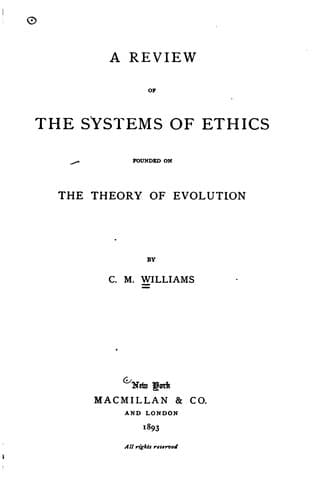
A Review of the Systems of Ethics Founded on the Theory of EvolutionWilliams, Cora May
Philosophy
A Review of the Systems of Ethics Founded on the Theory of Evolution
Williams, Cora May
Ethics, Evolutionary
The process by which the moral law (or rather, the law of conduct which
includes, but is not coincident with the moral law) is developed, is a
process of generalization. It corresponds to a vast induction carried on
by the race as organized in society. Beginning with modes of conduct
which are seen to be bad, society gradually perceives that the ultimate
principle of classification must be by the primary feelings, that rules
of conduct must be expressed in terms of character, and other rules
which concern the application of these to more special cases must take a
subordinate position and be regarded as only of conditional value. All
these rules must necessarily correspond, within very narrow limits, to a
statement of the conditions of vitality of the tissue which they
characterize. In an ideal state of society, every general principle
would also be recognized in every particular rule. This is a result a
gradual approximation to which, rather than its actual attainment, must
be anticipated.
Morality implies action for the good of others in some sense. Society
may be regarded both as an aggregate and as an organism. There are
certain qualities which we may suppose to vary in the individual without
necessarily involving a change in the social structure. How is the
general rule, as distinguished from other rules, deduced from the
general principle of social vitality?
The law of nature has but one precept, "Be strong." But when we regard
the individual in his relations to society, the law takes on different
forms. This may be expressed by saying that the law "Be strong," has two
main branches, "Be prudent" and "Be virtuous," the first applying to
cases in which the individual is primarily affected, the other to those
in which the units are affected through society and the social factor
must be taken into account.
To find a classification of the virtues that will not run into infinite
detail or be a simple affirmation of the general principle, the internal
development of moral character under its emotional and intellectual
aspects may furnish a sufficient method. The general formula of primary
individual virtues is: "Be strong." The condition of vitality of the
individual as a complex of instincts, is expressed by the formula: "Be
temperate." And the class of virtues referring to the conditions of
intellectual efficiency, has the general rule: "Be truthful."
Public-domain text, read in full here on John Shaqi.
Reviews
Reviews
No reviews yet
Be the first to share your thoughts on this work.
Elsewhere in the archive
Join the Discussion
Join the discussion
Sign in to leave a comment or review.
Sign InorCreate an account