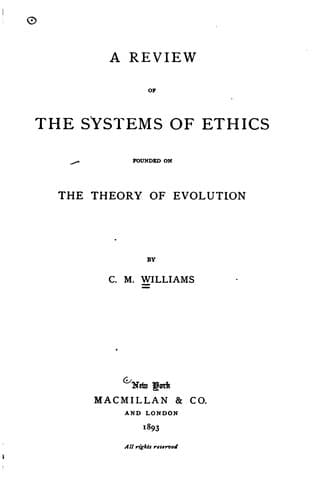
A Review of the Systems of Ethics Founded on the Theory of EvolutionWilliams, Cora May
Philosophy
A Review of the Systems of Ethics Founded on the Theory of Evolution
Williams, Cora May
Ethics, Evolutionary
Any association with a given end will have laws
determined with reference to that end. When we pass, however, from the
organ to the tissue, we still have an organic structure with certain
rules of conduct and corresponding instincts, but we no longer have a
definite end or a fixed material. The material, that is, is to be
regarded as developing and determining the development of the subsidiary
organs. And since the most efficient society normally survives, we may
inversely infer from the survival of a society that it has developed the
properties on which its efficiency depends. The actual laws existing at
any period may not represent the greatest degree of efficiency possible;
but they must be an approximate statement of the essential conditions.
The moral law, as applicable to all members of a society, defines some
of the most important qualities of the social tissue. It is as
independent of the legislature as are the movements of the planets. This
is true whether you resolve morality into reason or make it dependent
upon utility. The action of any set of people can no more change the
nature of facts than that of logical necessities. This is, however,
fully true only of morality as it ought to be in correspondence with
facts. Actual morality corresponds to men's theories about facts, and it
may, therefore, deviate from what the code would be if they were
incapable of error. But it is plain that, though it varies, it must vary
within incomparably narrower limits than other systems of law, because
its variation is determined by far more general conditions; it maintains
itself, so to speak, by the direct action of the organic instincts. The
doctrines of the greatest moral teacher, though somewhat in advance of
prevailing standards, are successful only in proportion as they are
congenial to existing sentiments, give articulate shape to thoughts
already obscurely present in the social medium. Like Socrates, the
reformer must be something of a midwife. Morality grows, and is not
made; that is, it is the fruit of a gradual evolution of the organic
instinct continued through many generations. The ordinary mind resists
any change in principles instilled into it from birth; the great masses
are sluggish in movement.
The moral law has to be expressed in the form: "Be this," not "Do this."
The existence of a character such that variations of circumstances will
cause no deviation from morality is the only security for morals. The
legislator is forced to classify conduct by its objective
manifestations. But the cunning of the man who desires to evade the code
can still devise innumerable methods of accomplishing his end
indirectly. Law permits what it does not prohibit, and is, therefore, in
danger of producing hypocrisy instead of virtue.
Public-domain text, read in full here on John Shaqi.
Reviews
Reviews
No reviews yet
Be the first to share your thoughts on this work.
Elsewhere in the archive
Join the Discussion
Join the discussion
Sign in to leave a comment or review.
Sign InorCreate an account