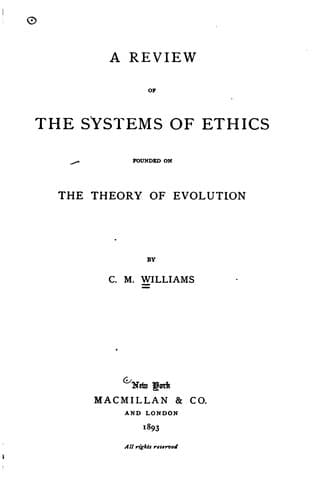
A Review of the Systems of Ethics Founded on the Theory of EvolutionWilliams, Cora May
Philosophy
A Review of the Systems of Ethics Founded on the Theory of Evolution
Williams, Cora May
Ethics, Evolutionary
The estimate of courage differs with respect to the two sexes, as does
also that of chastity. The historical explanation is simple; courage was
necessary in men in early social stages, to race-preservation; to women,
on the other hand, has been given, from early times, a class of social
functions not requiring courage. The estimate, once fixed, survives even
when some of its early conditions disappear. The savage acquired his
wife by knocking her down; to him the ideal feminine character must
have included readiness to be knocked down, or at least unreadiness to
strike again; and, as some of the forms of marriage recall the early
system, so in the sentiments with which it is regarded there may still
linger something of the early instinct associated with striking and
being struck.
The virtues of chastity and temperance occupy an intermediate position
between the virtues of strength and the directly social virtues. Some of
them are a part of the prudential, and others of the directly moral
code. Temperance is primarily prudential, but the sexual and parental
instincts concern the most intimate structure of society. Our
instinctive classification of temperance as higher than courage has good
reason; the classification of it as a personal virtue cannot be
maintained. A man whose vice injures only himself in the first place,
becomes incapable of benefiting others. As we condemn the man whose
character is bad, whether external circumstances do, or do not, give him
an opportunity of displaying it, so we object logically to the man who
is destroying his social qualities, whether the immediate effect of his
conduct tells upon himself or upon others. Another element, an
instinctive disgust at sensuality, seems to precede judgment upon
intemperance, with a strength not to be accounted for by a mere summing
up of consequences. The human hog revolts us as the smell of the sty
turns our stomach. The justification of the instinct is not that it
implies a judgment of what is useful, but rather that it is a useful
judgment. As men become more intellectual, sympathetic, and so forth,
they gain fresh sensibilities, which are not simple judgments of
consequences but as direct, imperative, and substantial, as any of the
primitive sensibilities. To get rid of the sensibility you must lower
the whole tone of the character. Asceticism, which has arisen chiefly at
times of great indulgence, may have been of use if only as a
demonstration of the possibility of conquering the prevailing passions.
In a similar manner, we may think a great reformer, a Howard for
example, admirable, though he neglects duties which must be performed in
the ordinary case. We thus admit that the general moral code of
benevolence prescribes different conduct according to a man's
opportunities and talents.
Public-domain text, read in full here on John Shaqi.
Reviews
Reviews
No reviews yet
Be the first to share your thoughts on this work.
Elsewhere in the archive
Join the Discussion
Join the discussion
Sign in to leave a comment or review.
Sign InorCreate an account