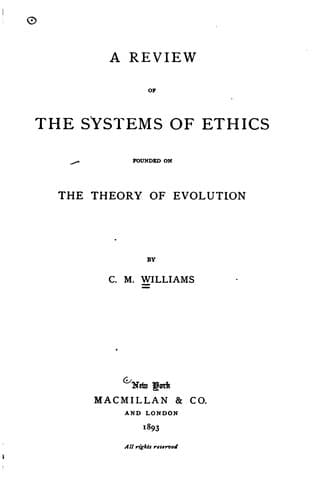
A Review of the Systems of Ethics Founded on the Theory of EvolutionWilliams, Cora May
Philosophy
A Review of the Systems of Ethics Founded on the Theory of Evolution
Williams, Cora May
Ethics, Evolutionary
Truth is a virtue of slow growth; the savage, like the child, is unable
to distinguish clearly the difference between imagination, hypothesis,
and historical statement. The perception of the utility of truth first
takes the external form: "Lie not," which corresponds approximately but
not perfectly to the internal rule: "Be trustworthy." The internal rule,
as such, is the higher; the external may have exceptions.
We come, at last, to the directly social virtues of justice and
benevolence. So far as truth and temperance are strictly virtuous, they
may be classed, the one under justice, the other under benevolence.
There is no real conflict between justice and benevolence; so far as a
man is really benevolent, he will not wish to benefit some to the injury
of others. Justice seems to consist in the application to conduct of the
principle of sufficient reason.
It is not safe to infer altruistic intention merely from altruistic
consequences. The sexual appetite appears to be the most selfish of
impulses, in that it prompts to conduct often ruinous to its objects. On
the other hand, it is the root of all social virtues. We cannot be sure
that the hen who covers her chicks regards them as more than comfortable
furniture in the nest. Altruism begins with the capability of benevolent
intention; where the conferring of pleasure upon others becomes a
possible motive. The generation of pleasure in others' happiness has
been traced to association; but, though the pleasant association
doubtless prepares the way for the higher sentiment, the latter is
something more.
It is true that all conduct is egoistic, in the sense that all conduct
has its source in the pain and pleasure of the doer; but there is great
difference between conduct that regards human beings as mere means to
personal pleasure and that which takes into account their feelings as
sentient beings. Sympathy springs from the primary intellectual power of
representation. I cannot properly know a man without knowledge of his
thoughts and feelings. Cruelty is, in many cases, simple insensibility,
incapacity for projecting ourselves into the position of other beings.
We may desire the pain of others when it is useful as a deterrent, or
secures our own safety; yet to think about other beings is, in general,
to stimulate our sympathies, our sensibility being thus quickened by the
same power which implies intellectual progress.
Public-domain text, read in full here on John Shaqi.
Reviews
Reviews
No reviews yet
Be the first to share your thoughts on this work.
Elsewhere in the archive
Join the Discussion
Join the discussion
Sign in to leave a comment or review.
Sign InorCreate an account