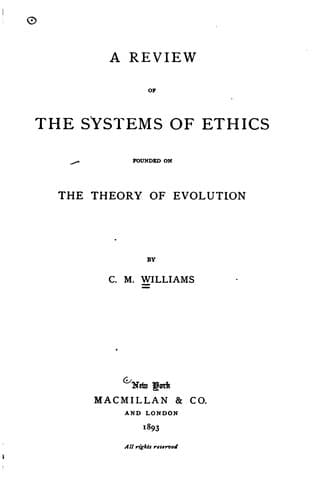
A Review of the Systems of Ethics Founded on the Theory of EvolutionWilliams, Cora May
Philosophy
A Review of the Systems of Ethics Founded on the Theory of Evolution
Williams, Cora May
Ethics, Evolutionary
To believe in the existence of sentient beings is to take into account
their feelings, to believe that they have feelings, which may persist
when I am not aware of them. A real belief, again, implies that, at the
moment of belief, I have representative sensations or emotions
corresponding to those which imply the actual presence of the object. To
take sentience into account is to sympathize, to feel with. The only
condition necessary for the sympathy to exist, and to be capable,
therefore, of becoming a motive, is that I should really believe in the
object, and hence have representative feelings. Systematically to ignore
these relations is to act as I should act if I were an egoist in the
extremest sense and held that there were no consciousness in the world
except my own. But really to carry out this principle is to be an idiot;
for an essential part of the world as interesting to me is constituted
by the feelings of other conscious agents, and I can ignore their
existence only at the cost of losing all the intelligence which
distinguishes me from the lower animals. It is true that this vicarious
sympathy, this pain at another's pain, may result in our simply getting
rid of our own pain by going away from the sufferer, removing him, or
dismissing him from our mind; as a fact, these methods are often
pursued. But in many cases, such a course is impossible without the
renunciation, at the same time, of many pleasures. If a man is to live
with his friends, he must share their joys and sorrows; the choice is
not between a particular pain and its absence, but involves the whole
question of the renunciation of companionship. Emotions are inevitable,
whether sympathetic or not, in proportion, not simply to the pain and
pleasure at the moment, but to the intensity and degree in which they
form part of the world of the individual,--the world constituted, not by
mere sensations, but by the whole system of thoughts and emotions
sustained by the framework of perception. The existence of pure
malignity must, it is true, be admitted; it may be partly explained as
love of the "sensational," the novel; the full explanation must be left
to the psychologist. Sympathy is the natural and fundamental fact. If
intellectual progress carried with it inferior sociability, it would
tend to be eliminated; the world would be to the stupid; it must carry
with it something which counterbalances the anti-social tendency. Reason
is that which enables a human being to take account of future, as well
as present pleasures. The working of the instincts or feelings, which
dictates conduct, approximately coincides with the prevision as to the
maximum of happiness obtainable by the agent; normally, it is prudent
to be virtuous; and the sympathetic motives, so to speak, always develop
within the framework provided by the other motives. To become reasonable
is to act on general principles, and to act consistently; and this
Public-domain text, read in full here on John Shaqi.
Reviews
Reviews
No reviews yet
Be the first to share your thoughts on this work.
Elsewhere in the archive
Join the Discussion
Join the discussion
Sign in to leave a comment or review.
Sign InorCreate an account