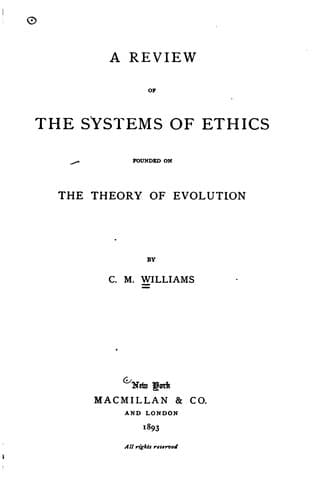
A Review of the Systems of Ethics Founded on the Theory of EvolutionWilliams, Cora May
Philosophy
A Review of the Systems of Ethics Founded on the Theory of Evolution
Williams, Cora May
Ethics, Evolutionary
Every character is developed under circumstances, and depends upon
mutual adjustment with these; we cannot disentangle the two factors.
Upon the power to infer future action the science of Ethics depends. The
action of the individual is not a matter of chance; in this sense it is
caused. But the instinct from which the action springs is not something
external to the man, which moves him; there is not the man plus the
instinct; the whole man, including the instinct, acts in a certain way,
in which he would not act if he did not possess the instinct. We are
accustomed to say that a man has inherited certain qualities; but the
man is not one thing and the inherited qualities another; the whole man
is inherited. Merit implies effort. This does not mean that effort,
taken absolutely, is the measure of merit. Such an assumption would lead
to our excusing men for the very qualities that make them wicked,--the
murderer because of his spiteful disposition, for instance. The man is
most meritorious who is virtuous with the least effort--provided always
that he has the normal passions of a man. By these, however, since they
are morally neutral, he is accessible to temptation and to a certain
struggle.
Conscience appears, historically, as a development of simpler instincts;
it is not a primary or a separate faculty; material morality makes its
appearance long before the conscious recognition of a moral law. The
existence of conscience is undeniable. Yet moralists are much given to
exaggerate the sorrow which it actually excites. In almost every case,
the pain which we feel for a bad act is complex, and due only in part to
our conviction that we have broken the moral law. If we regard
conscience as a separate faculty judging of action by some inherent
power, we have to attribute to it reason and feeling. It is not a
primary attribute of the agent (to borrow Spinoza's language), but a
mode of the attributes.
Public-domain text, read in full here on John Shaqi.
Reviews
Reviews
No reviews yet
Be the first to share your thoughts on this work.
Elsewhere in the archive
Join the Discussion
Join the discussion
Sign in to leave a comment or review.
Sign InorCreate an account