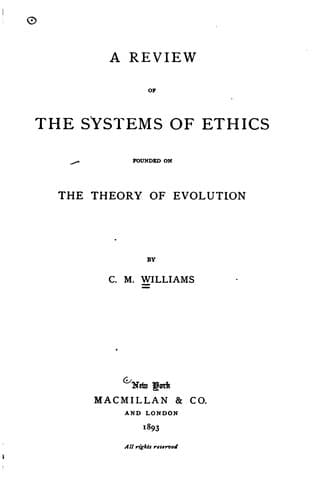
A Review of the Systems of Ethics Founded on the Theory of EvolutionWilliams, Cora May
Philosophy
A Review of the Systems of Ethics Founded on the Theory of Evolution
Williams, Cora May
Ethics, Evolutionary
There is, indeed, a sensibility which seems to have as good a claim as
any to be regarded as elementary, and which is clearly concerned in most
of our moral judgments: the sense of shame. This is excited by the
consciousness of the judgment of others. It operates, however, not only
in cases of a breach of morality; but often more strongly even in cases
not concerned directly with morality; and may even operate against the
moral code. But the variation is clearly not indefinite. Social
development implies the development of a certain type of character,
which includes, as essential, certain moral qualities; the
consciousness of the code and of the condemnation of certain classes of
acts, which it would cause, is implied in the sense of shame. The sense
is closely connected with the instinctive disgust before noticed. It
seems to have especial reference to decency and indecency. The value of
the sense of decency cannot be measured by a consideration of a
particular set of bad consequences from indecent actions other than the
shock to decency; we must consider the whole difference between a state
of society which does, and one which does not, possess it; it is an
essential symptom of refinement and delicacy. Again, the judgments of
conscience may be compared to aesthetic judgments. The difference between
the aesthetic and other pleasures depends upon the form of gratification,
not upon the instincts gratified, and seems to correspond to the
difference between work and play. The artist may appeal to our moral
emotions, giving us imaginary ideals; but emotion at the contemplation
of such types is in the aesthetic phase when we simply enjoy their
contemplation, and it passes into the practical phase as soon as it
begins to have a definite relation to the conduct of our lives. Only in
so far as the moral law has become internal, is the delight in heroic or
benevolent energy spontaneous; in so far, we may speak of the existence
of a moral, as of an aesthetic, sense. A man of fine moral sensibility
may, indeed, like the artist, perceive finer moral discords than can be
measured by formulae; and may thus supply a more delicate test. But the
complex problem of a difference in moral judgment may yet be solved
approximately by reference to the test of social welfare; the highest
type is that which is best fitted for the conditions of social welfare.
The collective experience of the race is always progressing towards a
more accurate solution of the problem.
Public-domain text, read in full here on John Shaqi.
Reviews
Reviews
No reviews yet
Be the first to share your thoughts on this work.
Elsewhere in the archive
Join the Discussion
Join the discussion
Sign in to leave a comment or review.
Sign InorCreate an account