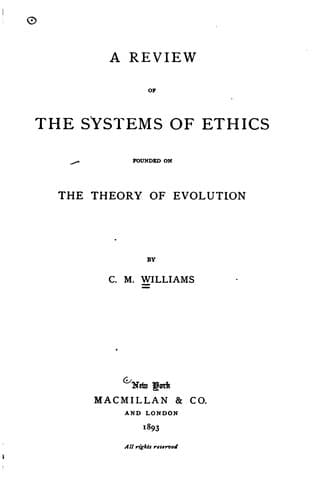
A Review of the Systems of Ethics Founded on the Theory of EvolutionWilliams, Cora May
Philosophy
A Review of the Systems of Ethics Founded on the Theory of Evolution
Williams, Cora May
Ethics, Evolutionary
In writing of the social instinct, Darwin begins with it as already
existent, and seems, moreover, to maintain concerning it a theory of
purpose elsewhere denied in his works and, indeed, antagonistic to the
whole principle of the struggle for existence. He says: "It has often
been assumed that animals were in the first place rendered social, and
that they feel, as a consequence, uncomfortable when separated from each
other, and comfortable whilst together; but it is a more probable view
that these sensations were first developed, _in order that_ those
animals which would profit by living in society, _should be induced to
live together_, in the same manner as the sense of hunger and the
pleasure of eating were, no doubt, first acquired, in order to induce
animals to eat."[12] If it were not for the expressions "should be
induced" and "to induce," the words "in order that," taken in connection
with what follows, might be interpreted as referring to mere sequence of
time, as, on page 199, where Darwin refers to the "social faculties"
simply as antecedent to society, they evidently do. For he says: "In
order that primeval man, or the ape-like progenitors of man, should
become social, they must have acquired the same instinctive feelings
which induce other animals to live in a body." The sentences referred to
which follow the first quotation are as follows: "The feeling of
pleasure from society is probably an extension of the parental or filial
affections, since the social instinct seems to be developed by the young
remaining for a long time with their parents; and this extension may be
attributed in part to habit, but chiefly to natural selection. With
those animals which were benefited by living in close association, the
individuals which took the greatest pleasure in society would best
escape various dangers, whilst those that cared least for their
comrades, and lived solitary, would perish in greater numbers. With
respect to the origin of the parental and filial affections, which
apparently lie at the base of the social instincts, we know not the
steps by which they have been gained; but we may infer that it has been
to a large extent through natural selection." The passage may possibly
be consistently explained by the idea of the Survival of the Fittest,
but it is at least very unclear in its wording. At the beginning of
Chapter IV. of the same book, Darwin also gives a synopsis of the
development of the moral sense from the social instincts, through the
pleasure of association and service, remorse being a result of the power
of representation, regard for the approbation and disapprobation of
fellows arising from sympathy with them until resulting habit plays a
very important part in guiding the conduct of the individual. Another
passage, however, again introduces an antagonism between habit,
instinct, and reason, and natural selection: "It is impossible to decide
in many cases whether certain social instincts have been acquired
Public-domain text, read in full here on John Shaqi.
Reviews
Reviews
No reviews yet
Be the first to share your thoughts on this work.
Join the Discussion
Join the discussion
Sign in to leave a comment or review.
Sign InorCreate an account