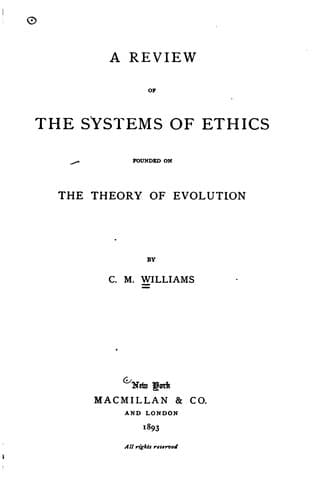
A Review of the Systems of Ethics Founded on the Theory of EvolutionWilliams, Cora May
Philosophy
A Review of the Systems of Ethics Founded on the Theory of Evolution
Williams, Cora May
Ethics, Evolutionary
The utilitarian theory, which makes happiness the criterion of morals,
coincides approximately with the evolutionist theory which makes health
of the society the criterion; for, as we have seen, health and happiness
approximately coincide. The utilitarian theory fails, however, in one or
two respects. It gets rid, as much as possible, of _a priori_ truths,
and rejects intuitions; it bases its argument on the assumption that all
knowledge is empirical and the ethical problem to be solved by a summing
up of the consequences of action. It thus neglects the truth which is
implied by evolution,--that the organism itself is solving the problem;
it neglects the instinctive sense generated by social evolution.
Moreover, it considers society as an aggregate of similar individuals,
taking little account of the variability of human desire. And, further,
the utilitarian theory lays its stress upon morality as extrinsic;
according to it, love of morality for its own sake, as love of the means
to the end, must be as unreasonable as the miser's love for his gold.
Association, in this sense, means illusion; and the more reasonable we
become, the more we should deliver ourselves from the bondage of such
errors; the theory fails just at the point where true morality begins.
Furthermore, in substituting the external rule: "Do this," for "Be
this," it seems to fall into the error of expediency. Though lying is
assumed to be, on the whole, detrimental to happiness, truth is
maintained to be desirable only where it contributes to happiness. The
utilitarian destroys, to some extent, the force of the objection to this
by asserting the danger of trusting ourselves. The force of this
objection is only seen, however, when it is applied, not to the
external, but to the internal code; we instinctively feel the danger to
character in the lie, and hesitate to trust human nature in the
establishment of such a precedent, just as we object to permitting the
taking of life even in cases where prolonged life means prolonged
misery, because we cannot trust human nature with the decision as to
life and death. We make binding laws of morality, and leave it to the
man of exceptional qualities to break them; for the generality of
mankind, the stricter code is safer.
Public-domain text, read in full here on John Shaqi.
Reviews
Reviews
No reviews yet
Be the first to share your thoughts on this work.
Elsewhere in the archive
Join the Discussion
Join the discussion
Sign in to leave a comment or review.
Sign InorCreate an account