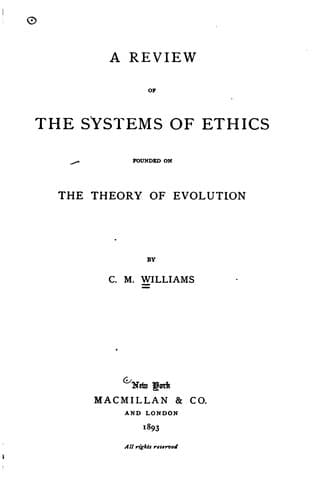
A Review of the Systems of Ethics Founded on the Theory of EvolutionWilliams, Cora May
Philosophy
A Review of the Systems of Ethics Founded on the Theory of Evolution
Williams, Cora May
Ethics, Evolutionary
If any man outside the pulpit were to ask himself what were the main
conditions of happiness, the answer would certainly include health as
the first, most essential, most sufficient condition. But the whole
process of nature, upon the evolutionist doctrine, implies a correlation
between the painful and the pernicious, and thus the elaboration of
types in which this problem is solved by an ever-increasing efficiency
and complexity of organization. Hence we may infer that the typical or
ideal character, at any given stage of development, the organization
which, as we may say, represents the true line of advance, corresponds
to a maximum of vitality. It seems, again, that this typical form, as
the healthiest, must represent not only the strongest type--that is, the
type most capable of resisting unfavorable influences--but also the
happiest type; for every deviation from it affords a strong presumption,
not merely of liability to the destructive processes which are
distinctly morbid, but also to a diminished efficiency under normal
conditions. However, the typical man, though he is, on this theory, the
virtuous man, is also much more than is generally understood by that
name. Happiness is the reward offered, not for virtue alone, but for
conformity to the law of nature, "Be strong." Beauty, strength,
intellectual vigor, aesthetic sensibility, prudence, industry, and so
forth, are all implied in the best type, and are, so far, conducive to
happiness. If virtue be taken in the narrower sense as implying chiefly
the negative quality of habitual abstinence from forbidden actions,
there is no reason to suppose that it coincides with happiness. You can
raise a presumption that moral excellence coincides closely with a happy
nature only when you extend "moral" to include all admirable qualities.
It is chiefly practical reasons which cause an attempted evasion of this
conclusion; the practical moralist holds that the non-social qualities
may be left to take care of themselves, but that stress must be laid
upon the social qualities as the more important, in order to obtain them
in society.
Public-domain text, read in full here on John Shaqi.
Reviews
Reviews
No reviews yet
Be the first to share your thoughts on this work.
Elsewhere in the archive
Join the Discussion
Join the discussion
Sign in to leave a comment or review.
Sign InorCreate an account