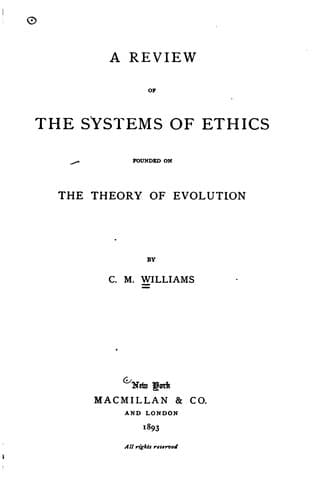
A Review of the Systems of Ethics Founded on the Theory of EvolutionWilliams, Cora May
Philosophy
A Review of the Systems of Ethics Founded on the Theory of Evolution
Williams, Cora May
Ethics, Evolutionary
Sympathetic motives may lead to self-sacrifice; but this is also true of
selfish motives; gin is a more potent source of imprudence, even in a
moderate sense, than family affection; and the sympathetic motives have
on their side the far greater intrinsic advantage, that they promote
ends more permanent, far richer in interest, and giving a proper
employment to all the faculties of our nature, besides the intrinsic
advantages that spring from friendly relations with the society of which
we form a part. It is, however, true that higher activity of any sort
may cause pain in an uncongenial medium, and that, hence, the man who is
morally in advance of his age may suffer through his morality; every
reformer who breaks with the world, though for the world's good, must
expect much pain. "Be good if you would be happy," seems to be the
verdict even of worldly prudence; but it adds in an emphatic aside, "Be
not too good." We must acknowledge that excessive virtue cannot be
recommended to the selfish person upon grounds intelligible to him.
There is, however, a general advantage in possessing more varied
possibilities of enjoyment, and in being on the side of the strongest
forces, those of progress.
Extreme self-sacrifice is sometimes demanded of a man by his moral
principles. Is the sacrifice worth making? Would Regulus have suffered,
from remorse, pain worse than death, had he chosen life at the cost of
honor, or would he have found, as many do, that remorse is amongst the
passions most easily lived down? To these questions can only be answered
that morality must often involve pain, but that the virtuous man
nevertheless chooses it.
We must thus conclude, leaving one great difficulty unsolved; and this
is because this difficulty is intrinsically insoluble; there is no
absolute coincidence between virtue and happiness. The scientific
moralist has to do with facts; beyond these he cannot go. From the
scientific point of view, we may hold that evolution implies progress,
and that progress implies a solution of many discords and an extirpation
of many evils; but there is no reason for supposing that all evil will
be extirpated and perfect harmony attained. New sensibilities bring with
them new dangers; even sympathy, when not guided by knowledge, may lead
to rash changes productive of evil as well as good. To improve, whether
for the race or the individual, whether in knowledge or in sympathy, is
to be put in a position where a new set of experiments has to be tried,
and experience to be bought at the price of pain.
Public-domain text, read in full here on John Shaqi.
Reviews
Reviews
No reviews yet
Be the first to share your thoughts on this work.
Elsewhere in the archive
Join the Discussion
Join the discussion
Sign in to leave a comment or review.
Sign InorCreate an account