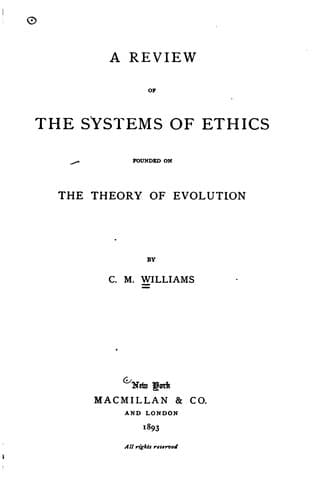
A Review of the Systems of Ethics Founded on the Theory of EvolutionWilliams, Cora May
Philosophy
A Review of the Systems of Ethics Founded on the Theory of Evolution
Williams, Cora May
Ethics, Evolutionary
Man is as unconditionally subject to the law of causality, psychically
and physically, as the merest atom. There is no such thing as chance;
but in this very fact lies a consolation. In the concept of
individualization in its broadest sense, is included the conception of
freedom, and in the very nature of man there is an indestructible
impulse to freedom; his being, as self-conscious, is identical with the
latter impulse. This increases with increasing civilization, and has
finally become the problem by the solution of which alone man can attain
to self-satisfaction. It is true that the power of choice is
inconsistent with the law of causality; but in the manner in which the
man, as a thinking being, takes his stand over against the species, he
becomes a person, an individuality. As one of the species, he shares the
characteristics of the species, is an expression of the species-idea,
and his action is determined outwardly by things; but it is so
determined only mediately by means of thought, of concepts; these are
the immediate determinants. Hence, man's relation to things is a
different one according to the grade of his knowledge. In so far as this
is adequate, that is, corresponds to the truth of actuality, his
relation is an active one; in so far as it is, on the contrary,
inadequate, the relation is a passive one.
Character is inborn and can never be effaced but only clarified, though
this least through the bitter experience of the results of action. As
the horse loses his sure-footedness after one fall, and falls again more
easily, so we lose, through many a deed, the motive furnished by the
consciousness of never having committed it, and have a greater tendency
to repeat it. If an act has bad results, it is more likely that an
attempt to avoid these results by cunning will be made at later
opportunities for the act, than that the act itself will be avoided.
And even if it were to be avoided, such avoidance would not constitute
an improvement of the character; the latter would but hide itself under
a mask to reappear at the first prospect of exemption from punishment.
That which alone can modify character is a considerable extension of
knowledge. For, since all things influence us only in proportion to the
worth we attribute to them, their power over us must differ according to
the correctness or incorrectness of our judgment. Therefore, the more we
regard things in the light of their actual worth and hence also in their
relations to each other, the more our character, beholding in these
relations the general as the true, will incline to avoid extremes in
action. A preponderantly sensual character remains such through life;
but there is no doubt that a careful education, which makes it
acquainted with nobler principles and develops a sensibility to true
beauty, may ennoble it; while, if the education is, on the contrary,
neglected, it must sink deeper and deeper into the mire of coarseness
and vulgarity.
Public-domain text, read in full here on John Shaqi.
Reviews
Reviews
No reviews yet
Be the first to share your thoughts on this work.
Elsewhere in the archive
Join the Discussion
Join the discussion
Sign in to leave a comment or review.
Sign InorCreate an account