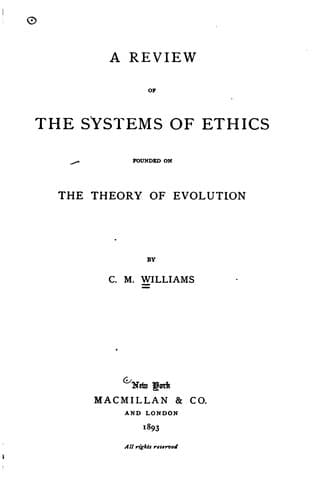
A Review of the Systems of Ethics Founded on the Theory of EvolutionWilliams, Cora May
Philosophy
A Review of the Systems of Ethics Founded on the Theory of Evolution
Williams, Cora May
Ethics, Evolutionary
It is true that beyond the science lies the art; we must incite the
intrinsic motives to good through the pressure of the social factor. A
certain disadvantage to the individual cannot form a reason for our not
endeavoring to make him moral as far as possible; the good of society as
a whole is involved; and even the man who is himself immoral sees the
advantage of living in a moral medium, and would prefer that the world
at large should not be guided by his own principles.
B. CARNERI
Carneri begins his book on "Morality and Darwinism" ("Sittlichkeit und
Darwinismus," 1871), with the rejection of the older Spiritualism in
favor of Idealism, on the ground that modern investigation has made it
impossible for philosophy to assume any foundation but one sanctioned by
science; and with a rejection of dualism in favor of monism, on the
ground that the investigations of Wundt and others have shown the
psychical and the physical to be identical.
Instinct is defined by Carneri as thought upon the standpoint of mere
sensation, but following the laws of the same logic as governs conscious
thought. There is, thus, according to his view, no exception to be taken
to the conception which represents instinct as the action of mental
force, the difference between it and human reason as one of degree only.
It is nevertheless a confusion which ascribes reason to the animals.
Even their intelligence is one-sided, since it does not reach
self-consciousness, and it is not to be regarded as an unqualified
improvement upon instinct, since the latter loses both in intensity and
in certainty of action when it no longer governs undisturbed by other
influences: only such animals as are endowed with intelligence
ever eat of injurious food. In human beings instinct has almost
disappeared;--almost, we say, since savages do many things in an
instinctive manner, and even civilized men at times perform acts which,
on account of the exceeding rapidity of their execution, cannot be
regarded as the results of reflection. Instinct may be compared to
polarity in magnetism, according to which opposites are attracted.
Instinct was evolved by natural selection. But intelligence and judgment
are doubtless also to be found even far down in the scale of species.
The brute consciousness is, nevertheless, only a transition-stage, in
which the individual is still lost in the species; and, as such, it is
not to be confused with human reason. Consciousness in the brutes is
purely subjective, a consciousness "fuer sich"; while in human beings it
is consciousness "an und fuer sich," consciousness that becomes
subject-object through the concepts developed by language.
Public-domain text, read in full here on John Shaqi.
Reviews
Reviews
No reviews yet
Be the first to share your thoughts on this work.
Elsewhere in the archive
Join the Discussion
Join the discussion
Sign in to leave a comment or review.
Sign InorCreate an account