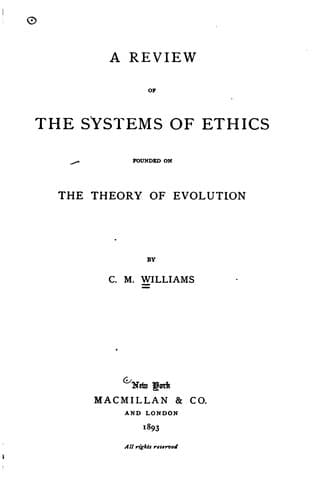
A Review of the Systems of Ethics Founded on the Theory of EvolutionWilliams, Cora May
Philosophy
A Review of the Systems of Ethics Founded on the Theory of Evolution
Williams, Cora May
Ethics, Evolutionary
Ethics ranks higher than morals, the latter merely comprising a
collection of particular rules of conduct which, as particular, bear the
stamp of the individual, the non-universal. The details of morality
change according to epochs and peoples. This change has been regarded as
an argument that there is no absolute but only relative good. But the
concept of the Good is, like the concept of the Beautiful, the fruit of
education; that is, it is the product of mind, which, through its own
evolution, arrives at Knowledge. When we do away with all concessions to
one-sided, extravagant desires, abstain from placing mind above the
universal law of causality, and are content with the facts made known to
us by science, we perceive that the absolute True, Beautiful, and Good,
bears the character of the Universal. In this universal character it has
always finally found expression in human life, and in this character it
will always find expression. The idea which reaches perfect expression
in the dialectic movement of these three concepts, the True, the
Beautiful, and the Good, has come into existence by the mediation of the
self-individualizing self-consciousness, just as the evolution on the
earth, which reaches its completion in man, is the outcome of the first
chemical process. Not only have the two one law,--(mind is only in so
far realized[65] as nature is expressed through it, and the actuality of
nature is its expression in mind) but both are, in fact, one, the
succession in their development on the earth being a succession only in
relation to the earth, and for us in this respect. Although to our
notion of time, thousands of millions of years lie between the two,
their separation does not represent a second for the universe and its
eternity, for the comprehension of which it must be disregarded.
The good man is he who does good for its own sake, without effort, not
out of momentary caprice, but out of perfect knowledge and conviction.
He is free, since he acts out of his own character, the law of nature
appearing as the law of his own mind; freedom lies in the absence of
discord and strife in the mind. The good man has strength of soul, just
as the man who lifts a weight without effort, not he who lifts it only
with the greatest effort, possesses strength of body.
There is no absolute Evil in contrast to the absolute Good. Evil is
negative. The perfection of man is identical with the attainment of
absolute Good through evolution.
Public-domain text, read in full here on John Shaqi.
Reviews
Reviews
No reviews yet
Be the first to share your thoughts on this work.
Elsewhere in the archive
Join the Discussion
Join the discussion
Sign in to leave a comment or review.
Sign InorCreate an account