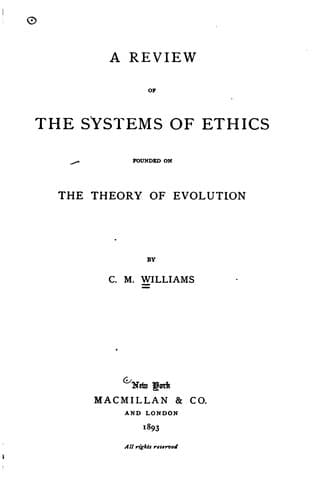
A Review of the Systems of Ethics Founded on the Theory of EvolutionWilliams, Cora May
Philosophy
A Review of the Systems of Ethics Founded on the Theory of Evolution
Williams, Cora May
Ethics, Evolutionary
Morality knows nothing of either reward or punishment; for it there are
only causes and effects. This truth, on which morality is based, lends
to the freedom out of which its activity proceeds a deeper worth. The
eternal laws of mind point the way by which mankind has to proceed; it
is the same way by which man has become man and by which he must
proceed, even if he did not will to advance thus. In the struggle for
existence, which knows only victory or destruction, progress is a
necessity of nature, but it is less painful and more rapid the more
clearly these laws come to be perceived by consciousness. Yet, however
clear they may be, it is only by a tireless endeavor which shrinks from
no sacrifice, that progress takes place. The end which morality has in
view is distant, for it is high; but only with its attainment will
mankind fully deserve its name when "struggle has been transformed to
labor, when no insignia are recognized but those of right, no weapon
used but intelligence, no banner raised but that of civilization."
In the volume, "Man the 'End' of Man" ("Der Mensch als Selbstzweck,"
1877), "a positive criticism of Hartmann's Philosophy of the
Unconscious," Carneri defines instinct as no form of real thought,
nothing dependent upon perception, but merely an inherited, mechanical
dexterity dependent upon sensation. For the assumption that thought is
the source of instinct must lead us naturally, on account of the
existence of the latter where the centralizing organ of thought is
absent, to the theory that thought is universal in nature; that is, we
shall arrive at a theory of atom-souls. It is evident here that not
Carneri's definition of instinct so much as his conception of thought
is changed from the one adopted in "Sittlichkeit und Darwinismus,"
thought being now limited, as it was not in the former book, to
self-conscious mental activity, assumed to be dependent upon nervous
centralization in the brain. In this book also, the author defines the
idea as something having mental existence, though not, he says, in any
metaphysical sense. His idealism is not of such sort that he recognizes
any other way to the attainment of ideas than that of science; and to
him "the service of the materialist who gives us information concerning
the function of the smallest nerve-fibres is of more worth than that of
the idealist who originates a whole philosophical system." The work of
philosophy lies in the rejection of all that is contrary to science, and
the clarification of ideals.
Public-domain text, read in full here on John Shaqi.
Reviews
Reviews
No reviews yet
Be the first to share your thoughts on this work.
Elsewhere in the archive
Join the Discussion
Join the discussion
Sign in to leave a comment or review.
Sign InorCreate an account