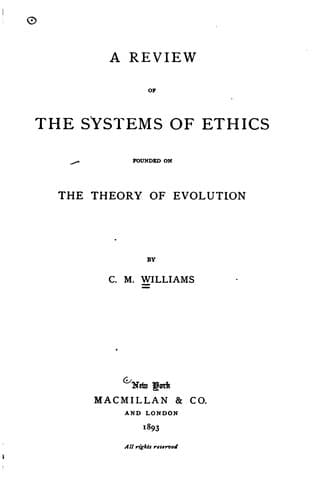
A Review of the Systems of Ethics Founded on the Theory of EvolutionWilliams, Cora May
Philosophy
A Review of the Systems of Ethics Founded on the Theory of Evolution
Williams, Cora May
Ethics, Evolutionary
The theory of an atom-soul and the theory of an organizing principle
must be abandoned as teleological, and so inconsistent with the facts of
evolution. The theory which holds force to be a transcendental
existence, a something outside of matter, must also be rejected. With
the endless divisibility is given an endless motion, inward or outward;
the endlessly divisible matter exists in endless motion, or what is the
same, the endless motion is the endlessly divided matter. Hence motion,
like matter, can never diminish; only the form of its appearance
changes.
The order in nature cannot be used as the basis of a teleological
argument; what we call order of nature is necessity as distinguished
from chance. For example, the statement that the life of the earth
requires the alternation of day and night means merely that, since day
and night alternate upon the earth, only such beings could arise and
continue in existence thereon as flourish under this alternation.
The first appearance of protoplasm introduces no strictly new thing, but
only a new form of matter with life-motion; and the formation of germs
is only a further step of the process. The most important characteristic
of all life is sensation. This is the form in which, in all living
things, that which in the rest of nature we call reaction, appears. That
it is so easy for us to say in the same breath, the animal possesses
sensation; and, by this particular excitation we produce in him this
particular sensation, has its reason in the fact that the animal is not
only capable of sensation, but is, moreover, continually in a state of
sensation. By the fact of its continual reaction upon sensation, it
keeps itself alive. Hence the two concepts coincide, so to speak;
sensation is to life what divisibility is to matter. We express with
these words more than a similitude, since all sensation is based upon
motion, is, indeed, motion, and every motion may be reduced to a
division or differentiation in the broadest sense of the word. All
further distinctions, as, for instance, with respect to the mode of
sensation (which belongs, without doubt, to plants as well as to
animals), we leave unnoticed; all differences in the forms of life are
but those of degree, though they may be wide differences of degree; they
are to be ascribed to the influence of outer circumstances.
Public-domain text, read in full here on John Shaqi.
Reviews
Reviews
No reviews yet
Be the first to share your thoughts on this work.
Elsewhere in the archive
Join the Discussion
Join the discussion
Sign in to leave a comment or review.
Sign InorCreate an account