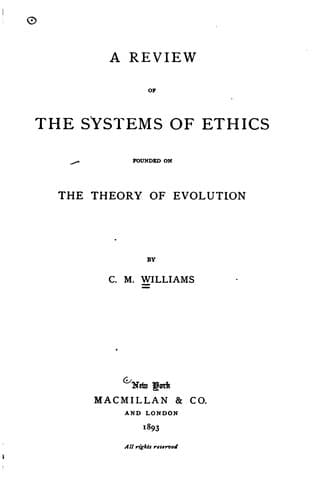
A Review of the Systems of Ethics Founded on the Theory of EvolutionWilliams, Cora May
Philosophy
A Review of the Systems of Ethics Founded on the Theory of Evolution
Williams, Cora May
Ethics, Evolutionary
The problem which first presents itself to us is that of Life in
general. The problem is inseparable from that of corporeality. If we
follow phenomena to their last conceivable reduction, we finally pass
from the perception of mass to the concept of matter; but further than
this we cannot go. At least, we can perceive only material things, and
that which we call the spiritual in distinction from the corporeal has
always something corporeal as its basis; and if we do not wish to
dispense with the reliable guidance of experience, we shall not overleap
this barrier. Science cannot reckon with supernatural factors.
What matter _is_ we cannot know; that it exists, however, that the
phenomena of nature are no empty seeming, sensation, as the felt result
of the mutual relation between us and the outer world, testifies.
Sensation is the basis of our self-consciousness, of the only full and
irrefutable certainty that we possess. As to what true Being or
Existence is, there is disagreement; but there can be none regarding the
fact that we are conscious of our sensations; and upon this
consciousness rests the postulate of the materiality[66] of all
existence. In order to assert the materiality of all phenomena, we are
forced to distinguish between a corporeal and a non-corporeal action of
matter; matter operates mentally when its division or differentiation
proceeds so far that the resulting phenomena can no longer be perceived
by the senses, but only conceived by thought. The indivisibility of mind
from corporeality follows directly from this definition of the mental
side of nature. We distinguish between the two only for convenience'
sake. The newer Psychology knows nothing of Sensuality in the old sense
of the word, since the basis of all psychical effects is physical.
For matter operating mentally, as for matter operating corporeally,
there are no specific energies; it is, as Wundt expresses it,
functionally indifferent. The differing results of a high
differentiation of centralized organisms arise in accordance with the
changing combinations of elementary parts and nerve activities. These
results are not, however, to be regarded as the mere effects of matter,
but as phenomena of the same, in fact, as the consummation and crown of
the whole evolution of nature. Even in the sense-organs we see the
differentiation of matter advance beyond the sphere of sense-perception.
Therefore, in distinguishing between mind and matter, we are still in
the realm of the natural, and follow the path of experience, if by
experience is understood not alone immediate experience, but also the
conclusions which directly or by strict analogy may be drawn from it.
Public-domain text, read in full here on John Shaqi.
Reviews
Reviews
No reviews yet
Be the first to share your thoughts on this work.
Elsewhere in the archive
Join the Discussion
Join the discussion
Sign in to leave a comment or review.
Sign InorCreate an account