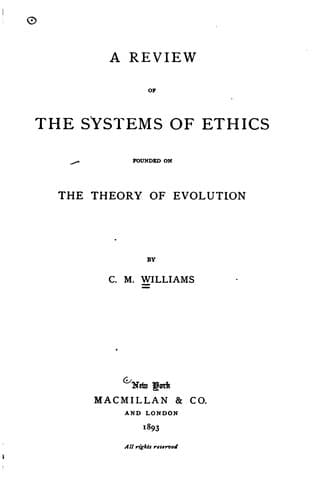
A Review of the Systems of Ethics Founded on the Theory of EvolutionWilliams, Cora May
Philosophy
A Review of the Systems of Ethics Founded on the Theory of Evolution
Williams, Cora May
Ethics, Evolutionary
In idealism, as long as it remains within proper bounds, there is
certainly truth; he who derides it, derides himself. But realism has
also its truth, as long as it does not misjudge the worth of concepts,
by which alone we clearly recognize what things are to us, what their
relations to us are, and so how we have to deal with them. Concrete
concepts inform us as to what is true and what is not true in phenomena.
There is no greater mistake than to suppose that what things are in
themselves, not what they are for us, is of importance to us; as if we
could have an interest in that which things are not for us. The decisive
point is the fact that, not things as they appear to us, but their
rightly conceived appearance, their appearance as understood by adequate
concepts, is the beginning and end of knowledge. Hence the true student
of nature can no more do without the concept than the true philosopher
can leave material perception out of account. Stiff-necked Materialism
is as one-sided as old-time Metaphysics; the one has no meaning for its
form, the other no form for its content; the one is a corpse, the other
a ghost, and each strives in vain to attain the warmth of life. Natural
Science and Philosophy must tread different paths, in so far as division
of labor requires them to do so; but they labor at the two sides of one
whole. Nature is not a machine, but life in its fullest form, and the
task set us is to understand her as she is, not to patch together a
nature out of disconnected scraps.
Public-domain text, read in full here on John Shaqi.
Reviews
Reviews
No reviews yet
Be the first to share your thoughts on this work.
Elsewhere in the archive
Join the Discussion
Join the discussion
Sign in to leave a comment or review.
Sign InorCreate an account