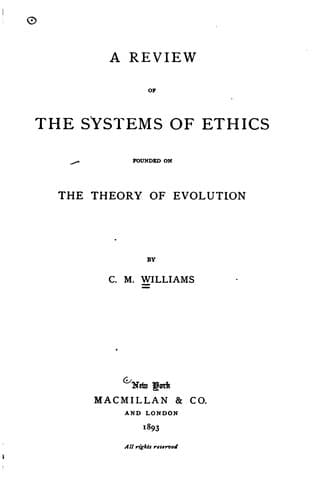
A Review of the Systems of Ethics Founded on the Theory of EvolutionWilliams, Cora May
Philosophy
A Review of the Systems of Ethics Founded on the Theory of Evolution
Williams, Cora May
Ethics, Evolutionary
Carneri adopts the definition given by Claude Bernard, to whom life is
neither a principle nor a result, but a conflict. To the chemical
synthesis, from which protoplasm results, is added, through mechanical
integration, morphological synthesis, to whose special form inherited
characteristics are related as elements. Through the conflict within
living forms, and between these and the rest of the world, motion,
attaining to the character of function, appears as continuous
consumption. Destruction and renewal are inseparable correlative
concepts. This fact is contained in the concept of the conservation of
force, work, and motion. We may distinguish between (1) latent life,
such as that accumulated in the germ, (2) the merely oscillating
plant-life, and (3) free animal life. With this distinction, we place
ourselves upon the standpoint of the individual, for whom there is both
beginning and end, and to whom renewal is subordinated to destruction;
for consumption, death is the characteristic of living in distinction
from non-living matter. If, therefore, we regard life as identical with
death, we merely assert that we consider death identical with life, and
that, in the broader sense of the word, for the universe as a whole,
there is no death. That which Claude Bernard designates as Construction
is the differentiation and division of labor arising in the process of
integration. The cell constitutes the first integration of protoplasm.
In it, motion takes place in a particular form, organizes according to
this form, causes division and synthesis, and impresses features of
character that, by their action and reaction with the environment,
either effect their own destruction, or else maintain their existence,
propagate themselves, become fixed, and undergo further evolution. In
this manner species arise and vary: and the more primitive the form, the
more variable it is; the more advanced, the more fixed. Hence the
invariable character of the germ-cells. In bone-formation, it is clearly
shown that special structure begins very early,--in the cell, namely;
but it is preserved only where it is aided by the necessary action and
reaction. Autonomic in itself, life submits itself to the general laws
of evolution.[67] As the direction of motion is determined for whole
groups of cells by the direction of the motion of the protoplasm in the
single cells, so organic function is determined by the grouping of the
irritable, contractile, sensible cells. From the first origin of life up
to its most perfect development, everything is formed at the cost of
other forms. If life is, therefore, to be conceived as a conflict, it is
a conflict as wide as the universe itself, and we say, with Claude
Bernard, that "life may be characterized, but not defined."
Public-domain text, read in full here on John Shaqi.
Reviews
Reviews
No reviews yet
Be the first to share your thoughts on this work.
Elsewhere in the archive
Join the Discussion
Join the discussion
Sign in to leave a comment or review.
Sign InorCreate an account