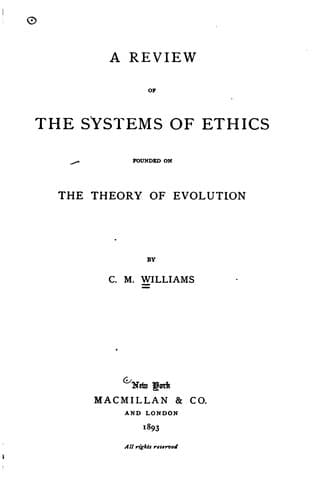
A Review of the Systems of Ethics Founded on the Theory of EvolutionWilliams, Cora May
Philosophy
A Review of the Systems of Ethics Founded on the Theory of Evolution
Williams, Cora May
Ethics, Evolutionary
Soul is, therefore, according to our definition, equivalent to animal
life, in contrast to the life of the plant. The significance of the
distinction lies in the intermediation of the general organic unity, not
in a qualitative division. The elements are the same; only their
connection is different, and that which distinguishes the animal is a
centralization of the organs. In referring to the possession of soul by
the animal, we simply point out the independent manner in which, by
reason of sensation, its impulses govern, and develop, through the
scale, up to consciousness and will. Of course the gradations are very
numerous, inasmuch as the functions of the soul are determined by the
development of the organism. The difference between animals whose
sensation attains clear consciousness and such as do not attain to more
than a mechanical action, does not concern us, as long as we regard the
psychical phenomena in their most general form. Every animal possesses
soul; we avoid the expression "_a_ soul," as giving the soul the
significance of something by itself. In like manner, we do not say that
_a_ life, but that life belongs to the animal. The chief condition
necessary to soul as to life consists in union to a whole, and soul
represents the gradation by which life lifts itself to the plane where
it becomes a mirror of the world.
Sensation, as centralized in the brain, becomes perception, the
sensation of a part becoming the sensation of the whole, a _feeling_ of
the individual. It is perceptions which cause movement. To find a
connection between perception as generally understood and the action of
the muscle would be as difficult as to show the connection between body
and soul in the sense of Spirit. But if we regard perception as feeling,
then the awakening of a corresponding impulse, and the transformation of
this into will, which finds expression in a corresponding motion, is
something so natural that it needs but a glance at the nerve-apparatus
in order to comprehend the rapidity of the whole process. With regard to
the unconscious character of the greater part of the process, and its
corresponding rapidity, we have to consider the gradual nature of the
development of the nervous system, the gradual drill of the parts, until
the whole process becomes perfect. By feeling is here not meant
necessarily feeling as pain or pleasure. This quality of feeling does
not necessarily belong to every perception, else thought, as a train of
perceptions, would be unbearable; a certain strength of feeling is
necessary in order that it may attain the character of pain or pleasure;
as we recognize a boundary at which sensation begins, so we recognize
one at which feeling begins to attain the character of pleasure and from
which, up to a second boundary-line, it continues to appear as pleasure;
beyond this line it appears as pain. Moderate feeling is beneficial to
the organism, immoderate feeling harmful; hence the appearance of the
Public-domain text, read in full here on John Shaqi.
Reviews
Reviews
No reviews yet
Be the first to share your thoughts on this work.
Elsewhere in the archive
Join the Discussion
Join the discussion
Sign in to leave a comment or review.
Sign InorCreate an account