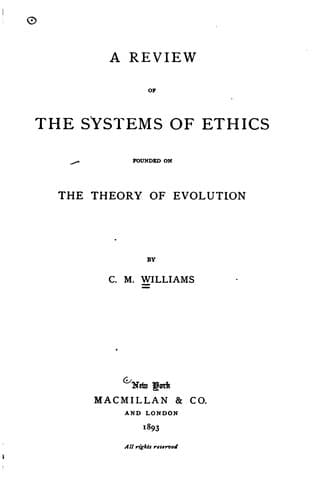
A Review of the Systems of Ethics Founded on the Theory of EvolutionWilliams, Cora May
Philosophy
A Review of the Systems of Ethics Founded on the Theory of Evolution
Williams, Cora May
Ethics, Evolutionary
one as pleasure, and of the other as pain. We say expressly "moderate,"
not "weak" feeling, because too weak feeling may also, under certain
conditions, be painful. Horwicz rightly protests against any attempt to
arrange the feelings in an exact scale, since a particular feeling may
lead to quite different phenomena of emotion, according to the
particular circumstances and the particular development which it
undergoes in the organism, and since it is furthermore nothing
changeless and distinct, but merely an energy that necessarily leads to
activity. Hence it is that the excitation which does not pass the stage
of sensation remains localized, but when it attains to the stage of
feeling takes possession of the whole individual, and brings the
essential tendency of his being[68] to expression.
As Carneri tends to interpret the sensation which he predicates of the
lower animals as a mere higher reaction of living matter, and thus
wholly mechanical, so he tends to regard the activity of all animals
which lack brain (under which he understands especially the nervous
developments found in the gray matter which contains Haeckel's
"soul-cells") as devoid of pleasure and pain, and due to mere
inheritance and force of habit. So the action of the ants is not to be
attributed to intelligence, but to mere reaction upon sensation due to
inheritance and exercise; and so the movements of a butterfly impaled
upon a red-hot needle would be attributable to the hindrance of its
flight, not to pain.[69] Thus, with Carneri, the words "sensation,"
"soul," "perception," and "feeling," lose their ordinary significance;
and this fact must be held in mind in the interpretation of his
assertions that "all animals have soul," and "all animals have
sensation."
Carneri further cites Haeckel's definition of the organism as a
cell-monarchy, in which different individuals, and different groups of
individuals, having different duties, are guided by a central power. He
does not intend thus to assume special centres for consciousness and
will, but only to assert that, through such centralization, the
expression of the whole individual, as total consciousness and total
will, takes place.
Not only the brain, but other parts of the nervous system, are affected
in perception; and the same parts are operative in remembrance. Thus the
association of ideas is explained.
Public-domain text, read in full here on John Shaqi.
Reviews
Reviews
No reviews yet
Be the first to share your thoughts on this work.
Elsewhere in the archive
Join the Discussion
Join the discussion
Sign in to leave a comment or review.
Sign InorCreate an account