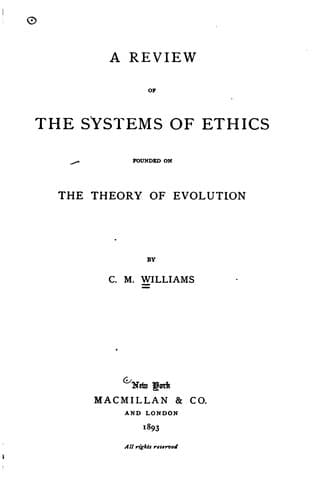
A Review of the Systems of Ethics Founded on the Theory of EvolutionWilliams, Cora May
Philosophy
A Review of the Systems of Ethics Founded on the Theory of Evolution
Williams, Cora May
Ethics, Evolutionary
For nature there is no good and evil. The animal which tears and devours
its prey is no worse than the swollen stream, that uproots the trees in
its course. With consciousness, intention awakes; yet in the brute this
is only secondary; the brute distinguishes between pain and pleasure,
but not between these as the result of its own action in distinction
from that of nature outside itself. Only the self-consciousness of the
human being knows good and evil; nature does not know evil, for she does
not know the opposition on which it is based. There is wisdom in the
story of Genesis, which sees in the beginning of knowledge, the
commencement of evil. The awakening of self-feeling is the beginning of
a chasm, through the full development of which the individual is at
length separated from nature. With self-consciousness and the feeling of
boundless isolation that therein comes over him, man begins his ethical
development.
But the ethical does not begin with the human being known to us by
natural history; even yet there are races of man which stand lower than
many species of animals; and the early development of moral activity was
of necessity much more of the nature of that which we call evil than of
that which we call good. The mind is a sort of light; and as warmth is
indivisible from the motion which we call light, and the first warmth of
the sun could only burn, so the motion which we call mind could at first
only have destroyed; self-consciousness, in its earliest stages, can
have produced only the intense feelings which lie nearer pain than
pleasure. As man came to have intention, and gained new wants in
development, he could regard the intentions of his fellow-men only with
distrust. Envy, hatred, dislike, were developed long before the family,
and, later, the tribe furnished opportunity for love. Self-consciousness
could, at first, interpret good and evil only as having reference to
self, just as it also conceived its freedom as that of its own caprice.
The desire for happiness and endeavor to attain it is the primary
incentive to all human undertakings. It is erroneous to suppose that man
is nearer to the brutes by this impulse; the animal does not possess it,
has only the impulse to self-preservation.
Public-domain text, read in full here on John Shaqi.
Reviews
Reviews
No reviews yet
Be the first to share your thoughts on this work.
Elsewhere in the archive
Join the Discussion
Join the discussion
Sign in to leave a comment or review.
Sign InorCreate an account