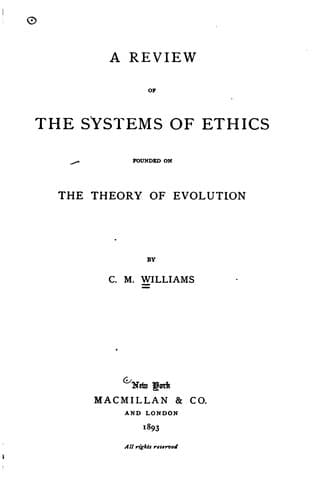
A Review of the Systems of Ethics Founded on the Theory of EvolutionWilliams, Cora May
Philosophy
A Review of the Systems of Ethics Founded on the Theory of Evolution
Williams, Cora May
Ethics, Evolutionary
As long as the animal remains upon the plane of mere instinct, it has
only blind impulses.[70] Only in the most highly organized animals do we
find the first traces of conscious, though not yet of self-conscious,
will. In that the animal knows what it will, it distinguishes clearly
the objects of its will, and hence its own impulses. Upon the earlier
plane of mere self-preservation, the beneficial, harmful, and
indifferent were not yet made inward, but only distinguished outwardly
by nature in the struggle for existence, in which the fittest survived;
in consciousness, however, the harmful and advantageous become inward,
taking the form of pain and pleasure. But the animal never gets beyond
the concrete case,--in which his inherited instincts, working with a
rapidity and freedom we often see imitated in the passions of men,
sometimes act so advantageously as almost to deceive us into believing
them the result of reflection; yet sometimes, again, bring most
disastrous results. The animal never attains to a notion of the Whole.
Associations and general perceptions the higher animal species have, but
not concepts.
Impulses appear, in their primary form in the animals, as passions.[71]
The first beginning of the ethical may be found in the passion of love
in the broadest sense of the word, as sexual love and the love of
offspring. The first is chiefly exacting, the second is higher, in that
it gives.
That which divides man physically from the brutes is merely the union of
qualities, all of which, but never all of which united, we find among
the animals; that which divides him mentally from them is self-conscious
thought, developed by means of speech. Through the development of
attention, which arises in connection with a greater and greater
centralization, sensation becomes perception, this develops further to
general perceptions, and is still further perfected to concepts.
Carneri believes primitive man to have been, not more benevolent than
the animals, but less so. Leaving out of account the carnivorous
animals, the brutes seem to satisfy their own wants without interfering
with the satisfaction of others, and, except where the possession of
females is concerned, to live in peace with each other. On the other
hand, the influence of man upon the domestic animals may be seen in the
greed of the dog, who, as capable of instruction, takes on himself all
the evil qualities of his master. The cat, who is not so intelligent as
the dog, is not thus influenced.
Public-domain text, read in full here on John Shaqi.
Reviews
Reviews
No reviews yet
Be the first to share your thoughts on this work.
Elsewhere in the archive
Join the Discussion
Join the discussion
Sign in to leave a comment or review.
Sign InorCreate an account