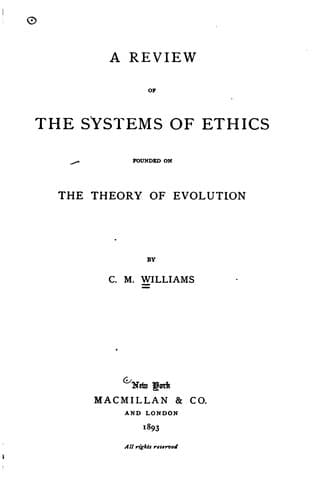
A Review of the Systems of Ethics Founded on the Theory of EvolutionWilliams, Cora May
Philosophy
A Review of the Systems of Ethics Founded on the Theory of Evolution
Williams, Cora May
Ethics, Evolutionary
Carneri's examination of the primary laws of thought can be only touched
upon here. In the law of Identity, or, negatively speaking, the law of
Consistency,[72] there comes to our consciousness a more general Species
which includes a determinate species. "The adequate, clear, correct,
corresponding[73] concept is consistent with itself," means, the
adequate concept finds itself again in every object which it includes.
The law of Identity expresses, therefore, not entire sameness, with
which the cessation of all thought would be reached, but simple
consistency. It affords us, thus, the means of recognizing the Untrue in
that which is not what it is called, hence also the means of recognizing
the True. The law of Excluded Middle contains an extension or doubling
of the law of Identity, in that the identity here appears, not in the
form of consistency, but in that of contradiction; as, "either--or." Not
one, but two cases are supposed, only one of which can exist or be true.
The disjunctive proposition which corresponds to it is not less
determinate than the categorical proposition which corresponds to the
law or judgment of Identity, but is rather, on the contrary, a more
forcible affirmation of it. In this determinate nature lies the worth
of the Excluded Middle. Du Bois Raymond's address on the Limits of
Knowledge has caused much joy to conservative thinkers; but these have
made much more out of it than it really means. There is either for us a
transcendental, or there is not; and if not, then we are limited to the
knowledge of nature. The scientific limit set to our knowledge by our
hypotheses and theories is, however, merely a limit set for the purpose
of rounding knowledge to a whole, not of closing it to a further
advancement; but such hypotheses must be consistent with experience and
founded upon it; otherwise we leave knowledge behind us and abandon the
hope of it. We cannot say what, within the province of science, man will
not know, except that he never will know everything.
Public-domain text, read in full here on John Shaqi.
Reviews
Reviews
No reviews yet
Be the first to share your thoughts on this work.
Elsewhere in the archive
Join the Discussion
Join the discussion
Sign in to leave a comment or review.
Sign InorCreate an account