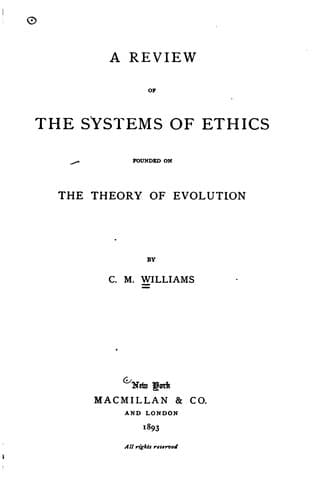
A Review of the Systems of Ethics Founded on the Theory of EvolutionWilliams, Cora May
Philosophy
A Review of the Systems of Ethics Founded on the Theory of Evolution
Williams, Cora May
Ethics, Evolutionary
The law of Causality is the most important law of thought, after that of
Identity. Reason and result are often confused with cause and effect.
The reason on account of which we do a thing is not, however, the cause
by which it occurs. The cause is the complexity of all conditions which
make it possible, and the reason of its performance coincides with a
conscious design on our part that constitutes our purpose. Causality has
nothing in common with the concept of purpose. The principal of
Sufficient Reason has been made the bridge between Causality and Design.
Probably human experience reached first the conception that nothing
occurs without sufficient reason, and only later, by a further mental
step, the conviction that everything for which the necessary conditions
exist takes place. With this conviction, the concept of causality became
clear; but, at the same time the bridge which connects it with the
theory of design in the succession of events was destroyed, so that only
a logical leap can restore us to this incomplete conception of earlier
experience. Causal necessity excludes purposed necessity. That which
takes place may be regarded as, in one direction, conformable to an end,
but may, on the other hand, conform to no end in any direction. A
succession of events conforms to purpose only in so far as it is
regarded by a particular consciousness which combines it in thought with
ends of its own or such as it ascribes to another consciousness. In the
law of Causality, as in the law of Identity, the necessity of
self-consistency and the self-consistency of Necessity reaches
expression. The sufficient reason is simply the completeness of the
conditions, with the existence of which the event takes place, and the
absence of which the event fails to take place.
Spinoza's "Will and intellect are one and the same" is the ethical law
of Identity. All thought is willed; that is, indivisible from a certain
coloring which it has in virtue of its identity with the will, just as
all will is connected with thought; there is, indeed, a will-less
thought, which might, however, just as correctly be called "unthinking
thought,"[74] just as "unthinking willing" is, in reality, will-less
willing. In all mental operations, the identity of the two functions is
found. A will is unthinkable without something willed--an end, given by
thought. It is the fact that, in his practical life, man recognizes
purpose as a necessity, which causes him to read purpose into nature.
Public-domain text, read in full here on John Shaqi.
Reviews
Reviews
No reviews yet
Be the first to share your thoughts on this work.
Elsewhere in the archive
Join the Discussion
Join the discussion
Sign in to leave a comment or review.
Sign InorCreate an account