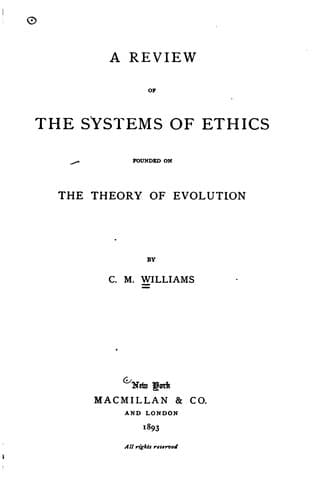
A Review of the Systems of Ethics Founded on the Theory of EvolutionWilliams, Cora May
Philosophy
A Review of the Systems of Ethics Founded on the Theory of Evolution
Williams, Cora May
Ethics, Evolutionary
What we aim at, in this analysis, is a true Realism in the conception of
the Purposeful. The Purposeful is that which conduces to an end, the
Useful. From Individuality follows the individual nature of ends. Every
man has his own ends, and in the attempt to attain his ends does not
hesitate to set himself in opposition to all the rest of mankind. If he
is sufficiently energetic and cunning, he may even succeed, for a time,
in his endeavors, to the harm of humanity. Yet to have the whole of
humanity against oneself is to endeavor to proceed in the direction of
greater resistance, and the process must, sooner or later, result in the
triumph of the stronger power. In the struggle for existence, in its
larger as well as its smaller manifestations, the individual seeks, with
all his power, to satisfy the impulse to happiness which arises with
conscious existence; while the species, as the complex of all energies
developed by its parts, has an impulse to self-preservation of its own,
which, by its action as type, has originated and preserved for centuries
the conception of changeless kind.
"Here is the beginning of the dawn, whose sun, however, in order to
become visible and impart warmth, must rise still higher. The certainty
afforded in the law of Identity in positive form, in the law of
Contradiction in negative form, in the law of Excluded Middle in the
form of an opposition, and in the law of Sufficient Reason in
conditional form, is based upon Causality, Community of Species, or
Totality. For this reason, deduction and induction are only then to be
relied upon when the first form of reasoning has for its middle
proposition one that expresses causality, community of species, or
totality, and the latter form of reasoning takes these for its point of
departure. The analysis of Deduction is of worth as clarifying and
confirming thought, and thus extending its field as often as the
syntheses of Induction stand the proof of the process of clarification.
The supernaturalism of Dualism leads to a dead, the natural character of
Monism to a living, dialectic,--to the dialectic of Becoming. The
concept assumes a concrete form, and, as higher and higher rising sun,
enables us to conceive what it will be to us as Idea. The understanding
knows nothing of ideas; their realm is that of the reason; yet since the
reason is but a higher development of the understanding, the
commencement of this dawn must be perceptible in it. Moreover, the
division which we make between the two originates in our genetic
treatment of the subject, which seeks to explain the concept by showing
the course of its development. Yet the distinction is no empty
abstraction which may not claim life and form to a certain extent. The
human being is always the whole human being; but he is not always
uniformly developed, either physically or mentally. In one individual
the understanding, in another the reason, manifests itself more plainly
in thought.
Public-domain text, read in full here on John Shaqi.
Reviews
Reviews
No reviews yet
Be the first to share your thoughts on this work.
Elsewhere in the archive
Join the Discussion
Join the discussion
Sign in to leave a comment or review.
Sign InorCreate an account