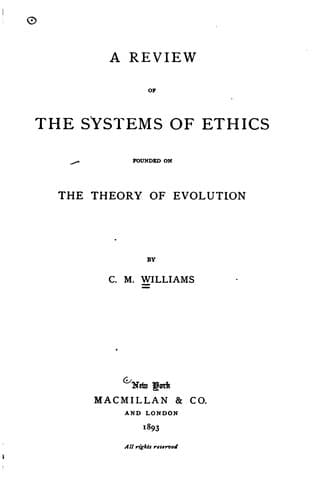
A Review of the Systems of Ethics Founded on the Theory of EvolutionWilliams, Cora May
Philosophy
A Review of the Systems of Ethics Founded on the Theory of Evolution
Williams, Cora May
Ethics, Evolutionary
"At the basis of identity lies a concept which throws light upon the
teleological principle. This is the concept of the General. The basis of
the principle of identity is a concept of species which embraces the
general in contrast to the singular and particular; just as the judgment
of Identity constitutes an advance to still greater Generality. The
concept of the General which reaches expression in species coincides
with the concept: Law of Nature. The Law is, for a particular circle of
events, what the Species is for a particular circle of objects. As in
the Species, the characteristics are expressed which an object must
exhibit in order to belong to it, so in the Law the conditions are
expressed which much exist in order that the instance included under it
may take place. The relation of Identity to Causality is unmistakable.
Species and Law include no mere plurality of objects and instances, for
as often as the instance comes to pass the law is fulfilled, and the
number belonging to a species is, in conception, limitless. Worlds like
our earth may come into existence again and again; hence specimens of a
certain species, eternally destroyed, may eternally renew themselves,
and instances which fall under a certain law may eternally occur. Simply
their conditions must exist in order that they may occur. Such cases
form, therefore, a whole; and this is Totality in Little." The
importance of every whole which sets itself over against the greater
whole has already been noticed. The former whole constitutes the concept
of Individuality which, as Undivided Unity, becomes independent. "The
limitlessness which we claim for the whole is one of conception; we thus
seek to make that which is incomprehensible conceivable." The concept
does not need to be imagined; it may be thought. "Every one knows what
he means when he opposes the whole to the part. The whole is not a
larger part, but the opposite of the part, as 'all' constitutes the
opposite of the many and the particular."
Public-domain text, read in full here on John Shaqi.
Reviews
Reviews
No reviews yet
Be the first to share your thoughts on this work.
Elsewhere in the archive
Join the Discussion
Join the discussion
Sign in to leave a comment or review.
Sign InorCreate an account