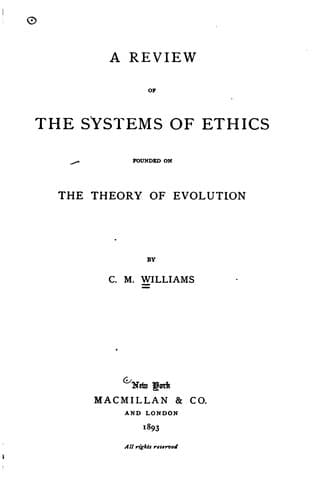
A Review of the Systems of Ethics Founded on the Theory of EvolutionWilliams, Cora May
Philosophy
A Review of the Systems of Ethics Founded on the Theory of Evolution
Williams, Cora May
Ethics, Evolutionary
who are the most fully self-determined. A real freedom and conquest of
necessity can, on the contrary, be attained only by obedience. Just as,
in the animal, the summation of impulses and desires reaches a focus in
feeling, so in man, in proportion to his development, the summation is
in consciousness, the focus of which is the point of concentration of
the will's activity. Spinoza's "Will and understanding are one" means:
the activity of the will is the realization of the activity of thought.
Every one, the more self-sacrificing, as the less self-sacrificing man,
does that which is to him the pleasantest; egoism turns the scale in
both cases; only in the one case the egoism has a basis of broader love.
And since we act according to our conception of things, the question of
our responsibility is the question of our full possession of
consciousness. The necessity of nature must take away our desert, as far
as a future life and its reward are concerned; but from the standpoint
of a being who desires happiness and attains to it through evolution,
necessity gains a new aspect. Natural Selection is Natural Necessity.
Yet not in the understanding, as such, but in the reason, is the
reconciliation of the same with will. Reason in the narrower sense is a
higher development of the understanding, constitutes its completion and
perfection, and presupposes a high degree of culture; though in a wider
sense, as the half-unconscious modification of the impulses by
adjustment to the needs of the species, it develops early in man. By it
alone man becomes man in the full sense of the word. The activity of the
mere understanding is an analytical, that of the reason a synthetical
one, the return of cold consciousness to warm feeling, of abstract mind
to concrete nature. Truth lies, for the reason, in Totality; hence, to
it, the General alone is comprehensible. It has to do, not with abstract
concepts, to which nothing in the realms of the mental or physical
corresponds, but with concepts of species, concrete concepts, which we
call, in distinction from abstract concepts, ideas. By ideas is not
meant existences in the Platonic sense, but the Typical in species.
Public-domain text, read in full here on John Shaqi.
Reviews
Reviews
No reviews yet
Be the first to share your thoughts on this work.
Elsewhere in the archive
Join the Discussion
Join the discussion
Sign in to leave a comment or review.
Sign InorCreate an account