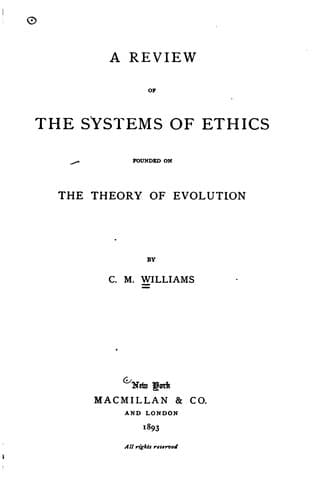
A Review of the Systems of Ethics Founded on the Theory of EvolutionWilliams, Cora May
Philosophy
A Review of the Systems of Ethics Founded on the Theory of Evolution
Williams, Cora May
Ethics, Evolutionary
The impulse to happiness which arises with consciousness as thought and
will, calls itself "I." It is the individual who, with every nerve-cell
and every drop of blood, attempts his own realization. But all
individuals are alike in this, that they reach, at last, a point where
they recognize the fact that their ego is but a miserable half which
needs a Thou to its completion. In the union of the Thou and the I, the
first I becomes a complete and perfect I. Man and woman both realize
that only together do they represent the whole human being. I and Thou
together constitute a We. The ego remains after, as before the union,
the axis upon which the whole world turns. But the egoism of mere
understanding is, by a broader thought, elevated to the altruism of
reason. As the highest union of thought and will, the reason becomes
Idea in and for itself, actual, absolute Idea. With the We was born the
Saviour who should reconcile the sharply opposed factors of awaking
consciousness. The light of his gospel spread in wider and wider
circles; man and woman no longer beheld, each, merely his own happiness
in the other; they saw their mutual happiness in their children, and
their own and their children's happiness in friends, and their own and
their children's and their friends' happiness in their fellow-men. The I
of the reason is the self-conscious We.
The struggle for happiness has brought forth, out of the privileges and
endeavors of individuals, civilization in its present form. Want and the
necessity for labor have been the spur to endeavor and advance. Through
the concepts of ends and of intention, the self-conscious will further
evolved ideas, which themselves undergo a struggle in the activities to
which they give rise; and this is no longer the struggle for existence,
but the struggle for civilization.
There are three Ideas which, arising out of the extension of the I to
Thou and We, are the spring of all ethical conceptions; these are Love,
Humanity, and Public Spirit.[75] Love is the passion of passions and is
the spring of all capacity to altruistic emotion. Love is life in its
highest degree;[76] and by the manner in which a human being loves one
may know what manner of man he is, and what will be the nature of his
feelings towards his fellow-men in other relations of life. A man's
conduct towards women is the surest test of his character. That which
Spencer calls Integration, that which has created all nature, from the
first germ to the perfect human being, and, as preservative cell-labor,
still continues to create,--this infinite Something comes to
consciousness in the human being, as Love. On the lowest plane it can
appear only as simple impulse; but what, developing from stage to stage,
it can accomplish, the history of Love shows us.
Public-domain text, read in full here on John Shaqi.
Reviews
Reviews
No reviews yet
Be the first to share your thoughts on this work.
Elsewhere in the archive
Join the Discussion
Join the discussion
Sign in to leave a comment or review.
Sign InorCreate an account