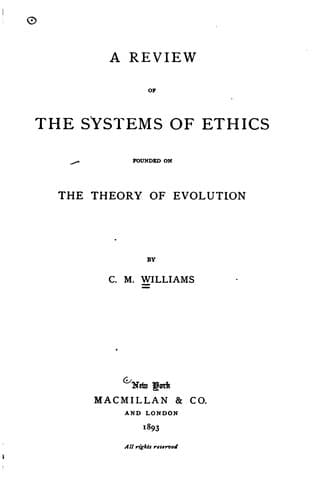
A Review of the Systems of Ethics Founded on the Theory of EvolutionWilliams, Cora May
Philosophy
A Review of the Systems of Ethics Founded on the Theory of Evolution
Williams, Cora May
Ethics, Evolutionary
Theological Ethics is directly opposed to Historical Ethics as well as
to Philosophical Ethics. It builds upon tradition, upon truth as
something historically revealed. So far, it might appear as if
Theological Ethics were related to Historical Ethics. But the system of
the former does not recognize the method of scientific research, since
the revelation on which it is based is due, according to its doctrine,
to an interposition of supernatural forces not to be explained by the
physical, psychological, and social laws that serve as the foundation of
historical science. It demands a unique position for its historical
basis, and asserts that this must be looked at in an entirely different
light from that in which the rest of the history of the world is
regarded. It appears to approach Philosophical Ethics in instituting an
examination of the worth of historic acts and modes of life. But it
undertakes this examination, not according to any principle that can be
found in nature, but from the point of view of a supernatural revelation
of an ideal. Its foundation is an absolute principle of Authority; its
good is that which is God's will. But how is the individual to be sure
as to what, in the single case, is God's will? By the inward testimony?
How is he to distinguish certainly between such and his own natural
thoughts and feelings; what means of distinction can be applied? In
passing thus to the province of Psychology, we assume a human means of
distinction, and the principle of Authority loses its force. Or if it be
said that we should receive this principle of Authority because it
answers to a need of our nature, we may ask how we know that the need is
one that should be satisfied? Its mere existence cannot guarantee that.
Or how, then, are we to distinguish which of other wishes and needs of
our nature should, and which should not, be gratified? Is the principle
of Authority to decide this? Then we argue in a circle.
A similar circle is adopted by such theologians as attempt to combine
the two assertions: "The good is good because God wills it"; and "God
wills it because it is good." If the good is identical with God's will,
this means that he wills it because it is his will; if he, however,
first recognizes something as good, and therefore wills it, then his
will bows to a law and rule, and is not, in itself, the cause whereby
the Good is good.
Have we not, as a fact, already broken with the absolute principle of
Authority as soon as we begin to reflect, to endeavor to bring the
various commandments of Authority into harmony with each other, thus
applying the measure of our own reason to them?
Public-domain text, read in full here on John Shaqi.
Reviews
Reviews
No reviews yet
Be the first to share your thoughts on this work.
Elsewhere in the archive
Join the Discussion
Join the discussion
Sign in to leave a comment or review.
Sign InorCreate an account