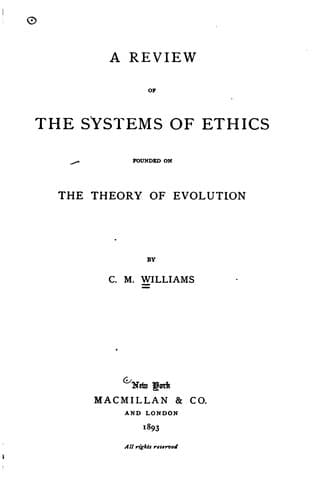
A Review of the Systems of Ethics Founded on the Theory of EvolutionWilliams, Cora May
Philosophy
A Review of the Systems of Ethics Founded on the Theory of Evolution
Williams, Cora May
Ethics, Evolutionary
But it is not these inner contradictions alone which hinder
Philosophical Ethics from making use of theological assumptions; that
which has called Philosophical Ethics into existence and lends it
interest, is the conviction that the ultimate reason of the ethical must
lie in man himself. However lofty may be the ideal, it can become man's
ideal only through his own recognition of it as ideal. For this reason
Socrates was the founder of Ethics by the command: "Know thyself!" In
this command is expressed the principle of free investigation, the
opposite to that of blind obedience. The desire to make Ethics as far as
possible independent of assailable assumptions is likewise active in the
establishment of a system of Philosophical Ethics.
In the great, sometimes too great, regard paid to the distinction
between the subjective and the objective worth of actions, and the
contest as to the relative importance of the two factors, the fact is
often overlooked, that the standard by which ethical judgment is
pronounced is itself of subjective nature. The question arises as to
wherefore we seek a general and objective standard.
It is a fact that human beings reflect upon their own acts, pronouncing
them, according to the result of this reflection, good or bad. How are
such judgments as these possible?
We will suppose, first, the simplest conceivable case, namely, that the
acting subject pronounces judgment on his own act without consideration
of the existence of other beings. Such a judgment must presuppose
memory; but it presupposes something more, namely pain or pleasure
through memory; an end is aimed at only because the thought of a result
causes pleasure. In the simple case supposed, the feeling which
determines the end can be only that of the individual himself, and the
latter will judge the act as good or bad according as it has affected
his own life. The character and significance of the judgment will depend
on whether the feeling of pain or pleasure is determined only by the
single moment or has reference to the life of the individual as a whole.
The lower the life of consciousness, the more isolated and independent
are the single moments of time in relation to each other, and the less
is the significance of the memory and the thought of the ego as a whole
embracing the single moments with their content. Only a half-unconscious
instinct hinders the individual from losing himself in the moment; the
instinct of self-preservation leads him to consider the future and to
make use of the experience of the past. The more he loses himself in the
moment, the less is the power of judgment, since comparison and action
and reaction of the different states cannot take place. The single
moment bears to all others the relation of an absolute egoist, who does
not wish to relinquish any part of its satisfaction for their advantage.
Public-domain text, read in full here on John Shaqi.
Reviews
Reviews
No reviews yet
Be the first to share your thoughts on this work.
Elsewhere in the archive
Join the Discussion
Join the discussion
Sign in to leave a comment or review.
Sign InorCreate an account