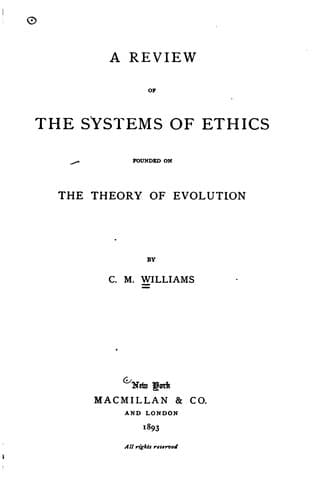
A Review of the Systems of Ethics Founded on the Theory of EvolutionWilliams, Cora May
Philosophy
A Review of the Systems of Ethics Founded on the Theory of Evolution
Williams, Cora May
Ethics, Evolutionary
The reasoning of Philosophical Ethics must not be confused with
practical reflection. In the last we are led by instincts and impulses,
by motives of which we are, for the most part, wholly unconscious, by
thoughts and feelings the first origin of which we cannot designate. We
follow the "positive morality" to which we have accustomed ourselves and
which is, in part, an inheritance of our species. Ethics as an art
precedes Ethics as a science; the aim of the latter is partly to show by
what principles the former is guided, and partly to correct these
principles.
The ethical principle broadens out, thus, from the single moment of the
individual life until it embraces the whole of mankind; but there are
many points in the course of the development at which we can make a
stand, and there may, therefore, be as many philosophical systems as
there are larger or smaller totalities. The position of the man who
holds fast consistently to a principle that determines the criterion by
the family, the caste, the nation, a sect, as highest totality, is as
unassailable as we have seen that of the individualist to be. The
psychologic-historical evolution alone can bring us, through the changes
which it produces in the feelings, beyond these criterions. In other
words, every criterion has a psychologic-historical basis. He who is to
recognize and carry out practically the principle of the greatest
possible welfare, must be no egoist or individualist, no fanatical
patriot or sectarian; this is the subjective condition necessary to the
objective principle. The conscience which is to be regulated by the
objective principle is always itself the condition of the recognition of
this principle. A system which leaves this fact out of consideration
takes on a dogmatic character. The basis of all ethical judgments is
feeling. By this is not meant, however, that the standpoint of an
individual cannot be influenced by argument; the feelings are always
connected with concepts, and discussion of these concepts is both
possible and must react upon them even if only very gradually.
Conscience is not infallible in its application of the objective
principle; a wider experience may show it to have erred. Conscience is
highest authority, but still an authority which may continually perfect
itself. The objective principle makes possible the mutual correction of
different consciences and the self-correction of the conscience of the
individual through self-judgment.
Public-domain text, read in full here on John Shaqi.
Reviews
Reviews
No reviews yet
Be the first to share your thoughts on this work.
Elsewhere in the archive
Join the Discussion
Join the discussion
Sign in to leave a comment or review.
Sign InorCreate an account