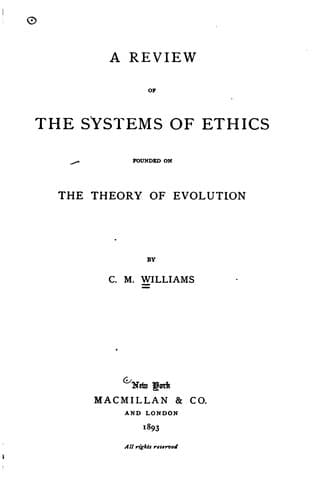
A Review of the Systems of Ethics Founded on the Theory of EvolutionWilliams, Cora May
Philosophy
A Review of the Systems of Ethics Founded on the Theory of Evolution
Williams, Cora May
Ethics, Evolutionary
others; every exceptional position must be justified by the demands of
the general conditions of life; on the other hand, a society is the more
perfect the more freely and more independently the single members move,
and the larger the number of different possibilities it realizes, if, at
the same time, unity is preserved and attains an ever higher character
and ever increasing validity.
When the ethical feeling develops, upon the basis of sympathy, to the
feeling of duty and justice, the principle included in the above law
becomes the standard according to which the individual judges his own
actions as well as those of others, and pronounces them good or bad. The
good is that which preserves and develops the welfare of conscious
beings.
The ethical principle now arrived at applies to the deeds of conscious
beings, presupposing an end in view. Unconscious nature affects man's
life, but its workings have no ethical character. The ethical judgment
is itself determined by the principle on which it is pronounced, and
hence it serves to produce greater welfare. This is especially to be
seen where the judging and the acting individual are one and the same
person; in other cases, it becomes a special problem to bring the acting
individual to the recognition of the principle; this is a problem of
psychologic-pedagogical nature.
The word "welfare" is used in preference to utility or happiness in
order to prevent misunderstanding, and may be defined as including all
that serves to satisfy the needs of man's nature. Ethics must take into
consideration all the gradations of life, and cannot, therefore,
distinguish in the beginning between outer and inner, higher and lower,
welfare. Such a distinction is already an ethical judgment, and can be
made only after determination of the ethical criterion. Another mistake
is the stress often laid upon momentary feelings of pain and pleasure.
Pain signifies, it is true, the beginning of the disintegration of life,
and pleasure its normal and harmonious development; yet each must be
considered in its relation to the whole consciousness, the whole
character, and the whole social state. So-called utilitarianism has
injured its own cause by resolving consciousness into a sum of feelings,
and society into a collection of individuals. The significance of single
feelings of pain and pleasure for the welfare of society cannot be
determined as if the problem were a simple arithmetical one.
Public-domain text, read in full here on John Shaqi.
Reviews
Reviews
No reviews yet
Be the first to share your thoughts on this work.
Elsewhere in the archive
Join the Discussion
Join the discussion
Sign in to leave a comment or review.
Sign InorCreate an account