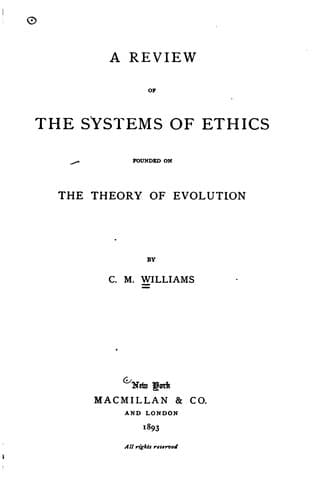
A Review of the Systems of Ethics Founded on the Theory of EvolutionWilliams, Cora May
Philosophy
A Review of the Systems of Ethics Founded on the Theory of Evolution
Williams, Cora May
Ethics, Evolutionary
In this way, too, Objective Ethics leads to Subjective Ethics. The
objective judgment not only presupposes a subjective basis, but also
finds some of its best objects in actions which spring from the same
mental constitution which is the basis of the judgment. Here, the basis
of mental constitution and the motive coincide; the ethical law demands
the existence of the moral disposition by which it itself exists in the
species. This Kant expresses in the assertion that it is a duty to
possess conscience. Since the recognition of duties presupposes the
existence of conscience, it might seem as if here were an argument in a
circle. But that this is an illusion may be seen from the fact that the
basis of ethical judgment and the motive do not necessarily coincide and
that it is not necessarily an imperfection when they do not coincide. It
may be necessary in some cases, in accordance with the principle of
welfare, that other motives than the sense of duty shall guide the
action; it may be necessary and healthful, for example, that in some
cases man should be led by the instinct of self-preservation, or by an
immediate sympathy, to labor for the welfare of others, and that
conscience should not be aroused in every single act. It may even be a
sign of perfection when actions that demand exertion and sacrifice are
carried out without the intervention of a sense of duty. Indeed, mental
drill in the end renders that which at first took place by means of a
long psychological process of reflection and will, direct and without
special consciousness of its reason.
All Ethics is practical Idealism. All systems assume an end, and an end
is not anything at present existing, but something which ought to be.
All systems assume, therefore, strong feeling, impulse, and endeavor,
combined with the image of that which is the object of the endeavor. But
the ideal must have points of contact with actuality, so that at least
an approach to it is practicable; it must be physically,
psychologically, and historically possible.
Public-domain text, read in full here on John Shaqi.
Reviews
Reviews
No reviews yet
Be the first to share your thoughts on this work.
Elsewhere in the archive
Join the Discussion
Join the discussion
Sign in to leave a comment or review.
Sign InorCreate an account