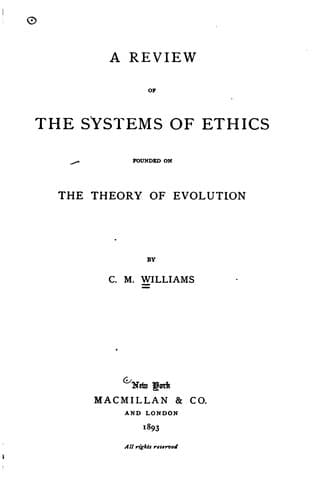
A Review of the Systems of Ethics Founded on the Theory of EvolutionWilliams, Cora May
Philosophy
A Review of the Systems of Ethics Founded on the Theory of Evolution
Williams, Cora May
Ethics, Evolutionary
Ethical ideals deviate from the actual in three ways. In the first
place, there is often in actual willing and doing something directly
opposed to the principle of welfare. In this case, the office of Ethics
is to restrain and forbid. To this function corresponds, in the
practical life of the will, the hemming by which involuntary, original,
or acquired impulses and inclinations are repressed. Again, actual
willing and doing often exhibit only a weak and imperfect realization
of that which Ethics demands. Here there must be an increase in the
degree as well as in the extent of the realization. To this corresponds,
in the practical life of the will, effort and attention, the power of
the will, through its influence upon conceptions and feelings, to react
upon itself. And finally, there may be, in willing and doing, a lack of
unity and harmony; various opposed tendencies and impulses may make
themselves felt. Here a process of harmonizing and concentration is
necessary. And to this corresponds, in the practical life of the will, a
drilling in connected action and trains of thought, and in the power to
make an end of reflection by decision. In all three cases, the principle
of welfare is to be followed; and the three processes are to be applied
not only in the development of the individual but also in that of
societies, and of the species.
That which manifests itself in conscience is a species-instinct. In the
feeling of judgment, the relation between central and peripheral factors
finds expression, neither of which, and least of all the central
factors, are developed by individual experience, but both of which are,
on the contrary, the product of the experience of the species. What Kant
called the Categorical Imperative is, in fact, an instinct; and every
instinct speaks unconditionally, categorically, gives no reasons and
admits of no excuse.
No instinct finds expression without the existence of conditions which
call it forth; but all manner of individual and social circumstances may
furnish such conditions.
When conscience begins to be conscious of its office, it manifests
itself as an Impulse.[77] The thought of actions which the instinctive
judgment has recognized, or to the performance of which it has perhaps
incited, is combined with pleasure, the conception of actions of the
opposite nature with pain. The tendency arises to linger with the former
and to repeat them, and to turn from the latter, if no stronger impulses
of another sort make themselves felt.
Public-domain text, read in full here on John Shaqi.
Reviews
Reviews
No reviews yet
Be the first to share your thoughts on this work.
Elsewhere in the archive
Join the Discussion
Join the discussion
Sign in to leave a comment or review.
Sign InorCreate an account