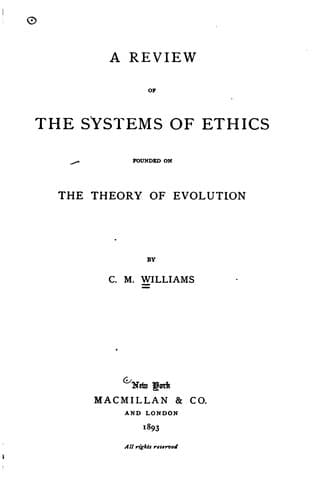
A Review of the Systems of Ethics Founded on the Theory of EvolutionWilliams, Cora May
Philosophy
A Review of the Systems of Ethics Founded on the Theory of Evolution
Williams, Cora May
Ethics, Evolutionary
Not less dogmatic than Fichte's assertion that conscience never deceives
us, is the view which regards a system of Ethics as merely the science
of the forms of society and of outward acts, and thus declares
conscience to be without authority in comparison with outer
circumstances and their demands. The law which we obey must always
express itself in the form of conscience. The light which illumines for
us all other things must be within ourselves.
Here we perceive the possibility of a conflict between Subjective Ethics
and Objective Ethics, between the two principles upon which Ethics is
founded. There can be no other solution to the problem than that we
shall follow the command of conscience, provided it speaks clearly and
after sufficient deliberation. It may be added that conscience can
correct and control itself, the later and more experienced conscience
criticising the earlier. As long as the individual acts according to his
best conviction, he is morally healthy; hence, from an ethical point of
view, a pernicious action carried out under the conviction that it is
good is to be preferred to a good action performed with the conviction
that it is bad. In the former case, the spring is pure; in the latter it
is corrupt. Only he who has courage to make mistakes can accomplish
anything great. It is not the cold and narrow, but those who are zealous
for the true and good, who thus err.
The power of self-correction can be developed only when some definite
principle or criterion may be found. Such a principle is that of
welfare. The problem of the application of this principle to action is,
however, like that of the application of the principle of causality to
actual phenomena, an endless one.
In close relation to the concept of Authority stands that of Sanction.
The Authority commands or forbids, the Sanction enables the command or
prohibition to remain in force. The sanction consists in the pain or
pleasure connected with the observation or transgression of the command,
in the reward or punishment which one brings on oneself through one's
action, in the heaven or hell which one approaches by the action. It is
only, however, when the authority itself is an outward one that the
sanction holds this outward relation to the action. In this outward form
it has no immediate ethical significance. The ethical character of an
action is dependent, in subjective regard, on its origin in the
intention of the performer, in objective regard, on its harmony with the
principle of welfare. What ethical significance could it have that here
a feeling of pain or pleasure not arising from the action itself, is
added to it? The outer sanction of reward and punishment is thus but an
educating sanction. The inner sanction consists in a feeling of harmony
and unity with one's own highest convictions, of consistency between
one's ideas and one's actual willing. Thus arises an inner peace that
may be stronger than all contradiction and opposition from without.
Public-domain text, read in full here on John Shaqi.
Reviews
Reviews
No reviews yet
Be the first to share your thoughts on this work.
Elsewhere in the archive
Join the Discussion
Join the discussion
Sign in to leave a comment or review.
Sign InorCreate an account