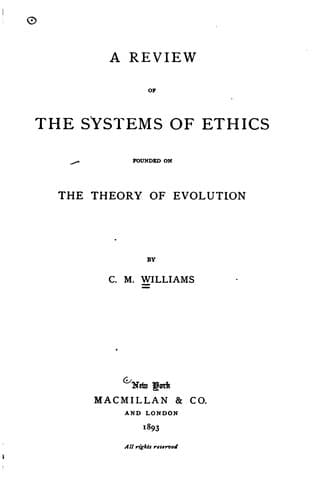
A Review of the Systems of Ethics Founded on the Theory of EvolutionWilliams, Cora May
Philosophy
A Review of the Systems of Ethics Founded on the Theory of Evolution
Williams, Cora May
Ethics, Evolutionary
Conscience may develop, without losing entirely its instinctive or
impulsive character, to practical reason. This takes place through the
development of the conceptions which determine the conscience as
impulse, to greater clearness and distinctness. When conscience acts as
instinct, the individual does not know what he does. If it acts as
impulse, he has a dawning consciousness of his acts. And when it
becomes practical reason, there arises a clear consciousness of ethical
laws and ethical ideals. In different individuals, conscience may appear
in very different forms and degrees, as instinct, impulse, practical
reason, sense of duty, sense of justice. Sometimes it appears as mainly
negative and restraining, sometimes again as chiefly positive, partly
harmonizing and partly increasing. Here it appears as enthusiastic
devotion, there as quiet and continuous tendency. It would be impossible
to name even the principal forms in which it may manifest itself, but it
is of great importance to call attention to the fact of these individual
differences, since we suffer at present from a dogmatism that has but
one measure for all these different manifestations.
We must go a step farther still. There may be men who possess no
strictly ethical feeling and who do not need it. Such men do what they
can with their whole heart without applying any reflective standard to
their own or others' acts. They entirely absorb themselves with
unflagging zeal in a work that perfectly corresponds to their
capabilities and impulses, without any doubt of its rightfulness and
import. They may devote themselves to art and science, to the service of
society, or to their family. Or they belong to the class of happy
natures who spread light and joy by their mere existence. They act in
accordance with the law, without being in possession of the law, and
what objection can Ethics have to offer to this? Ethics is for the sake
of life, not life for the sake of Ethics.
Since all ethical judgments have conscience for their psychological
basis, conscience is highest authority, highest law-giver, in comparison
with which every other authority is subordinate and derived. To wish to
go beyond one's conscience is to wish to go beyond oneself. When I yield
to another human being whose judgment I trust more than my own, this can
be justified only as it takes place through my conscience. Conscience is
infallible, if one understands by infallibility that it is, at every
instant, the highest judge; this infallibility does not mean, however,
that it does not err. Every earnest conviction takes the form of
conscience; the truth is not, however, secured by the mere form. Was it
not from conviction that Aristotle asserted the right of slavery, and
Calvin, with Melancthon's approval, sent Servetus to the stake?
Public-domain text, read in full here on John Shaqi.
Reviews
Reviews
No reviews yet
Be the first to share your thoughts on this work.
Elsewhere in the archive
Join the Discussion
Join the discussion
Sign in to leave a comment or review.
Sign InorCreate an account