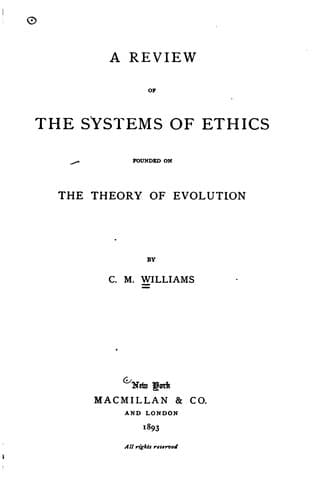
A Review of the Systems of Ethics Founded on the Theory of EvolutionWilliams, Cora May
Philosophy
A Review of the Systems of Ethics Founded on the Theory of Evolution
Williams, Cora May
Ethics, Evolutionary
The birth-hour of conscience is the time when, through the difference
between ideal and actuality, a certain feeling arises. Its death-hour
would be the instant in which the difference forever disappeared. Such a
disappearance might occur in two ways, either through the conquest of
the ideal by actuality or through that of actuality by the ideal. The
objection has been made to the theory of evolution that it fulfilled
the first of these possibilities, and so left no room for Ethics. But
the very fact of the existence of ethical impulses as the actual result
of evolution would seem to belie this theory. And indeed, we see that
evolution is not physical growth alone, but mental as well; and that the
important feature of man's development consists in his aspiration
through desires and impulses, which act as moving forces in his life.
Aspiration is necessary to his evolution, and indifference and lack of
sensibility an obstacle to it. The theory of evolution leads directly to
Ethics, in that it shows that the struggle for existence becomes, in its
higher forms, a common struggle for the continuance and development of
human life. The theory of evolution takes us, indeed, not only to, but
beyond, Ethics; for, according to Spencer, the ethical sense is but an
intermediate condition in a development toward a state of "organic
morality," where right-doing will be involuntary and natural, and a
special ethical sense no longer existent or necessary. Such a state
would constitute the realization of the second alternative mentioned
above, with which Ethics would come to an end. This state is
conceivable, and Ethics could have no objection to offer to it. Yet we
are still far from such a condition, and though we may strengthen our
courage and hope with the thought of a continual progress of human
nature, yet the assumption of such an end to evolution cannot have an
essential influence upon the method of Ethics.
We must, in fact, suppose that progress will bring us new problems and
new ideals, that, as the Ethics of the civilized man includes whole
provinces unknown to the savage, so many relations will certainly
present themselves in the future whose ethical significance our present
thick-skinned condition, our ignorance and egoism, prevent us from
comprehending.
Public-domain text, read in full here on John Shaqi.
Reviews
Reviews
No reviews yet
Be the first to share your thoughts on this work.
Elsewhere in the archive
Join the Discussion
Join the discussion
Sign in to leave a comment or review.
Sign InorCreate an account